“Regeneration Precedes Faith”. An AI-assisted Calvinist Rebuttal to Arminian David Allen’s Analysis of Key Verses in 1 John


1 John 5:1 Πᾶς ὁ πιστεύων ὅτι Ἰησοῦς ἐστιν ὁ Χριστός, ἐκ τοῦ θεοῦ γεγέννηται, καὶ πᾶς ὁ ἀγαπῶν τὸν γεννήσαντα ἀγαπᾷ [καὶ] τὸν γεγεννημένον ἐξ αὐτοῦ.

I. Does the Calvinist teaching “regeneration precedes faith” find support in Greek grammar?

Within Reformed (Calvinist) theology, it is maintained that regeneration logically precedes faith. That is, fallen human beings—being spiritually dead—are incapable of believing unless the Holy Spirit first imparts new life. This doctrine safeguards the monergistic character of salvation: it is wholly the work of God’s grace and not dependent on human initiative.

Several biblical texts are commonly cited in support of this position:
1. John 3:3–8 “Unless one is born again he cannot see the kingdom of God.” Jesus teaches that spiritual rebirth is a necessary precondition for perceiving and entering the kingdom. Faith—understood as seeing and believing—follows regeneration.
2. 1 John 5:1 “Everyone who believes [present active participle] that Jesus is the Christ has been born [perfect passive verb] of God.”  The Greek construction suggests that the state of having been born of God grounds the act of believing.
3. Ephesians 2:4–5 “Even when we were dead in trespasses, [God] made us alive together with Christ.” A dead person must be made alive (regenerated) before he can exercise faith.

II. Allen’s Challenge
In his article “Does Regeneration Precede Faith?” (JBTM, 2014), David Allen challenges the Reformed interpretation of 1 John 5:1, arguing that the claim “regeneration precedes faith” cannot be proven from Greek grammar. According to Allen, “The most that can be said from the Greek present participle and perfect tense verb combination is that the actions are contemporaneous” (p. 41). He appeals to the broader context of John’s writings, noting that passages such as John 20:31 present faith as the condition for life, not its result. Continue reading ““Regeneration Precedes Faith”. An AI-assisted Calvinist Rebuttal to Arminian David Allen’s Analysis of Key Verses in 1 John”

Definite (Limited) Atonement and Particular Redemption through Christ’s Death in Pauline Theology. Part 2/2

Definite Atonement and Particular Redemption through Christ’s Death in Pauline Theology

A) Paul consistently teaches definite atonement in several passages:
1. Acts 20:28 — The Purchased Church
Paul exhorts the Ephesian elders to shepherd the church “which he [God] purchased with his own blood.” He paid an incalculable price to save a people for himself through Christ’s death on the cross. The verb περιεποιήσατο (“purchased, obtained, gain for oneself”) denotes actual acquisition, not potential provision. This is an effective redemption, not a hypothetical one. Christ did not shed His blood in vain or indefinitely, but to redeem the Church effectually.

The object of this purchase is specific: the church (ἐκκλησία) — elsewhere called the flock, the sheep, and the bride of Christ (John 10:11; Ephesians 5:25). These are not open, universal categories; they are bounded images for a particular people. The atonement, therefore, is definite in both design and effect.

2. 1 Corinthians 11:25 Covenant Blood for a Defined People
“This cup is the new covenant in my blood” — The cup is a formal pledge that guarantees the salvation of those named within that covenant. The words echo Jeremiah 31:31–34: “And I will be their God, and they shall be my people.” The new covenant is presented as an unconditional covenant, ratified solely on the promise of the sovereign God. It gathers God’s exiled people from every nation, yet it gathers a defined people, not all people indiscriminately. Continue reading “Definite (Limited) Atonement and Particular Redemption through Christ’s Death in Pauline Theology. Part 2/2”

Definite (Limited) Atonement and Particular Redemption through Christ’s Death in Pauline Theology. Part 1/2


[responsivevoice_button voice=”UK English Female” buttontext=”Listen to Post”]

Introduction
This essay argues that Paul teaches definite atonement and particular redemption—the view that Christ’s saving death and atoning work are directed intentionally toward a specific group of people, namely the elect. Christ’s atonement does not merely open the possibility of redemption; it effectually accomplishes actual redemption. This stands in contrast to the Arminian position, which holds that Christ’s death provides only a potential redemption available to all who choose to receive it.

Rather than cataloguing a broad array of biblical texts, this essay anchors its analysis in one key passage—2 Corinthians 5:14-15—to highlight how the inner logic of the passage established by careful theological exegesis confirms Paul’s teaching of particular redemption. Continue reading “Definite (Limited) Atonement and Particular Redemption through Christ’s Death in Pauline Theology. Part 1/2”

The Arminian Conversion Prayer

[responsivevoice_button]

Free-Will – A Slave
“And ye will not come to me, that ye might have life.”—John 5:40

Excerpt from Spurgeon’s Sermon: Free Will—A Slave

IV. This brings us to the fourth point, THAT BY NATURE NO MAN WILL COME TO CHRIST,

It is true of all men in their natural condition that they will not come unto Christ.

The Son of God came, yet men rejected him. “Ye will not come to me that ye might have life.” It would take too much time to mention any more Scripture proofs. We will, however, refer to the great doctrine of the fall. Any one who believes that man’s will is entirely free,1Clarification – Spurgeon has earlier contrasted  “Free will” with “Free Agency”, stating, “Free agency we may believe in, but free-will is simply ridiculous. The will is well known by all to be directed by the understanding, to be moved by motives, to be guided by other parts of the soul, and to be a secondary thing. Philosophy and religion both discard at once the very thought of free-will; and I will go as far as Martin Luther, in that strong assertion of his, where he says, “If any man doth ascribe aught of salvation, even the very least, to the free-will of man [paraphrase – If anyone credits human free will with any part of their salvation, even the smallest amount], he knoweth nothing of grace, and he hath not learnt Jesus Christ aright.” and that he can be saved by it, does not believe the fall.

…Your fallen nature was put out of order; your will, amongst other things, has clean gone astray from God. But I tell you what will be the best proof of that; it is the great fact that you never did meet a Christian in your life who ever said he came to Christ without Christ coming to him. You have heard a great many Arminian sermons, I dare say; but you never heard an Arminian prayer – for the saints in prayer appear as one in word, and deed and mind. An Arminian on his knees would pray desperately like a Calvinist. He cannot pray about free-will: there is no room for it. Fancy him praying, Continue reading “The Arminian Conversion Prayer”

  • 1
    Clarification – Spurgeon has earlier contrasted  “Free will” with “Free Agency”, stating, “Free agency we may believe in, but free-will is simply ridiculous. The will is well known by all to be directed by the understanding, to be moved by motives, to be guided by other parts of the soul, and to be a secondary thing. Philosophy and religion both discard at once the very thought of free-will; and I will go as far as Martin Luther, in that strong assertion of his, where he says, “If any man doth ascribe aught of salvation, even the very least, to the free-will of man [paraphrase – If anyone credits human free will with any part of their salvation, even the smallest amount], he knoweth nothing of grace, and he hath not learnt Jesus Christ aright.”

A Calvinist Critique of Arminian Hermeneutics of Election and Salvation

[responsivevoice_button voice=”UK English Female” buttontext=”Listen to Post”]

Debates between Calvinism and Arminianism concerning salvation frequently center not only on doctrinal conclusions but also on differing approaches to biblical interpretation. Both traditions affirm the final authority of Scripture and seek to interpret biblical texts responsibly within their literary and theological contexts. Nevertheless, they often arrive at sharply different conclusions regarding divine election, grace, and human freedom.

This article examines several key passages commonly discussed in the debate and offers a Reformed (Calvinist) critique of Arminian hermeneutical method, particularly where Calvinist interpreters believe theological assumptions influence the reading of the text.

Definitions
Calvinist Monergism: All fallen human beings are spiritually dead due to sin. Salvation begins with God’s sovereign and effectual grace, which regenerates chosen individuals so that they are enabled to respond in faith to God’s offer of salvation. Salvation originates entirely in God’s initiative rather than in the human will. In this framework, regeneration precedes faith.
Arminian Synergism: All fallen human beings have been given God’s prevenient grace, which restores the ability to respond freely to the gospel. This grace is sufficient to enable faith but does not guarantee it. Faith is not caused irresistibly by grace but freely exercised by the individual. Salvation involves cooperation between prevenient grace and human response.

Romans 9:15–16 and the Ground of Salvation
Continue reading “A Calvinist Critique of Arminian Hermeneutics of Election and Salvation”

Does God Act Arbitrarily? Leighton Flowers Stigmatizes Calvinism to Win Debate

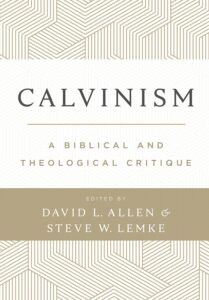
Leighton Flowers begins in his chapter, “A Critique of Unconditional Election,” published in the latest critique on Calvinism by David Allen and Steve Lemke, Calvinism: A Biblical and Theological Critique by emphasising the contrast between “the biblical choices of God which are not conditioned upon the merits of those chosen” with the Calvinist “unbiblical principle of God secret making arbitrary choices which unilaterally fixes the eternal destiny of every individual.”

A clear distinction must be drawn between the biblical choices of God, which are not conditioned upon the merits of those chosen, versus the Calvinist system, which logically entails the unbiblical principle that God secretly made arbitrary [emphasis original] choices before the foundation of the world, unilaterally fixing the eternal destiny of every individual. (CBTC 51)

Flowers concludes, I believe this doctrine, when logically and consistently applied, can be dangerous for the believer and the overall mission of the church and thus must be firmly refuted and soundly rejected as unbiblical teaching.” (CBTC 68) Continue reading “Does God Act Arbitrarily? Leighton Flowers Stigmatizes Calvinism to Win Debate”

The Problem With Arminian Middle Knowledge

Some young Calvinists I know are not sure how to respond to their friends who reject the Calvinist doctrine of God’s foreknowledge and predestination with a self-assured declaration, “No thanks, Calvinist predestination is theologically and logically problematic. I prefer Luis de Molina’s teaching of the “scientia media or middle knowledge as it is more coherent and persuasive.” These young Calvinists become unsettled and feel intimidated by the unfamiliar terminology thrown at them. However, a simple question would dispel the Molinist’s aura of sophistication. “As a Molinist, are you then a Jesuit or an Arminian? Since you are Protestant, I conclude that you are basically rebranding old-time Arminianism by using exotic language, granted that the idea of a divine middle knowledge is at the heart and soul of the Arminian view.”

This being clarified, we can focus on the theological problem with Arminian middle knowledge. To begin, classical theology referred to two kinds of divine knowledge: Continue reading “The Problem With Arminian Middle Knowledge”

Reformed Compatibilist Freedom. Part 2. Harry Frankfurt on Hierarchy of Motives and Free Will

The debate on free will has traditionally focused on how external constraints may prevent us from freely doing what we want to do. In contrast, modern psychology highlights how internal constraints (or drives) such as addictions, phobias and other kinds of compulsive behavior can be even more compelling in determining our actions. Frankfurt introduces several distinctions to our internal constraints or desires in order to shed light on they affect the way we exercise our free will.

(1) First-order desire: “A wants X”, is a desire to perform some action. A desire to eat a mango is a first-order desire; a desire for world peace is not.

(2) Will: a first-order desire which is effective, i.e. which causes one to do what one desires to do. A desire to eat mango is one’s will in Frankfurt’s sense, if that desire brings one to actually eat mango. Continue reading “Reformed Compatibilist Freedom. Part 2. Harry Frankfurt on Hierarchy of Motives and Free Will”

Reformed Compatibilist Freedom. Part 1. Critique of the Principle of Alternative Possibilities by Harry Frankfurt

A. Definitions
1) Determinism:
Determination is, intuitively, the thesis that, given the past and the laws of nature, there is only one possible future. [Van Inwagen, Essay on Free Will (Oxford UP, 1983), p. 65] In theological terms, an event (such as choice or action), is determined, that is, it must occur because there are sufficient conditions for its occurrence obtained earlier by the decrees of God.

The two major contending positions in the debate on determinism and free will are:
Compatibilism is the idea that there is no conflict between determinism and free will.
Incompatibilism is the idea that determinism rules out free will.

2) The principle of alternative possibilities (PAP)
PAP: A person is morally responsible for what he has done only if he could have done otherwise.

PAP has been at the centre of current debates about free will and moral responsibility. Harry Frankfurt, an accomplished philosopher observes: “Practically no one, however, seems inclined to deny or even to question that the principle of alternate possibilities (construed in some way or other) is true. It has generally seemed so overwhelmingly plausible that some philosophers have even characterized it as an a priori truth. (p. 1).

B. PAP Argument Against Determinism (Predestination)
Critics against predestination (as a form of causal determinism) contend that (1) causal determinism rules out free will or our ability to do otherwise. Then, they conclude via (PAP) that (2) causal determinism is inconsistent with moral responsibility.

Argument Part 1
1. If someone has free will, then he is able to do otherwise.
2. If determinism is true, then he is no able to do otherwise.
3. Therefore, if determinism is true, he does not have free will.

Argument Part 2
P1 A person’s act is free and morally responsible if and only if that person could have done otherwise. (PAP).
P2 Predestination teaches that no one could have done otherwise than what he is predestined to do.
P3 Predestination is inconsistent with moral responsibility (given PAP).
C1: Predestination is not true.

The subtext of this argument is that predestination cannot be true since it undermines human moral responsibility by denying free will and makes God culpable for the sins of his creatures.
Continue reading “Reformed Compatibilist Freedom. Part 1. Critique of the Principle of Alternative Possibilities by Harry Frankfurt”

Self-Determination, Freedom, and Choice of the Will in Calvinist-Arminian Debate

Arminians (and Open Theists) argue for “libertarian freedom” in their debate against Calvinists. Clark Pinnock explains that “a free action as one in which a person is free to perform an action or refrain from performing it and is not completely determined in the matter by prior forces-nature, nurture or even God. Libertarian freedom recognizes the power of contrary choice. One acts freely in a situation if, and only if, one could have done otherwise…It is the freedom of self-determination, in which the various motives and influences informing the choice are not the sufficient cause of the choice itself. The person makes the choice in a self-determined way.” [Clark Pinnock, Most Moved Mover, A Theology of God’s Openness (Baker, 2001), p. 127]

Roger Olson contrasts the Arminian view of libertarian freedom with the Calvinist view of “compatibilist freedom”. “Most Calvinists, when pushed to explain why persons act in certain ways or choose certain things, appeal to the strongest motive as explanation and then add that motives are not self-determined but given to persons by someone or something. In this theory people are “free” when they act in accordance with their desires, when they do what they want to do, even if they could not do otherwise. This “free will” is compatible with determinism.” [Roger Olson, Arminian Theology: Myths and Realities (IVP, 2006), p. 129] However, Olson rejects compatibilist freedom because it is incompatible with responsibility, which the Calvinists affirm. Olson dismisses compatibilist freedom because “It is hardly the most common meaning of free will or the meaning of “the person on the street” who talks about being free.” [An Arminian Account of Free Will]

Olson is being simplistic and tendentious when he asserts that for Calvinists “motives are not self-determined but given to persons by someone or something.” Continue reading “Self-Determination, Freedom, and Choice of the Will in Calvinist-Arminian Debate”