 Creation and Sacramental Participation: Hans Boersma and the Recovery of Christian Platonism. Paradigms of Creation and God. PCG 2/4.
In the previous post, we noted that one influential explanation for the rise of secular modernity is the emergence of nominalism in the late Middle Ages. According to this account, nominalism denied the objective reality of universals and thereby weakened the traditional conviction that creation reflects the eternal wisdom of God. The participatory link between creation and its Creator was gradually severed. Nature came to be viewed increasingly as a self-contained realm governed by impersonal laws rather than as a meaningful order that points beyond itself to God.
This narrative has been popularized by theologians associated with Radical Orthodoxy and by scholars such as Hans Boersma. It should be noted, however, that the claim that nominalism is the primary cause of secular modernity remains a contested historical thesis rather than an established fact. Nevertheless, the diagnosis has proven influential because it addresses a genuine problem: the modern tendency to view reality as disenchanted, mechanistic, and devoid of transcendent meaning. Hans Boersma’s book Heavenly Participation: The Weaving of a Sacramental Tapestry offers a significant contemporary attempts to recover a pre-modern Christian vision of reality. Although Boersma is not formally a member of the Radical Orthodoxy movement, his project is deeply sympathetic to its retrieval of participation metaphysics and sacramental ontology. He argues that much of the Christian tradition, especially before the rise of nominalism, understood creation through the lens of what he calls “heavenly participation” or “sacramental ontology.”
At the heart of Boersma’s proposal is a recovery of Christian Platonism. By this he does not mean a simple adoption of pagan philosophy but a Christianized understanding of reality in which created things derive their meaning and existence from their participation in God. According to Boersma, this participatory worldview enabled Christians to see creation, history, and the sacraments as realities that not only point to God but also mediate his presence.
1. Creation Participates in Divine Reality
The foundational concept in Boersma’s theology is participation (methexis). Created things do not possess autonomous existence or self-contained meaning. Rather, they exist and flourish because they participate in the being, goodness, truth, and beauty that originate in God.
For Boersma, the medieval Christian understanding of creation was profoundly sacramental. The created order was not viewed merely as a collection of physical objects but as a mystery filled with divine significance. “Mystery” here does not mean an unsolved puzzle. Rather, it refers to the hidden yet real connection between visible realities and invisible divine realities.
This distinction explains Boersma’s understanding of sacrament. A symbol merely points beyond itself to another reality. As the diagram given below explains [HP23], a symbol merely points to a higher, transcendent reality, but a sacrament participates (methexis) and mediated the presence of a true heaven reality(res) it represents.
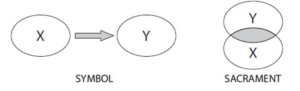
Creation with sacramental ontology goes beyond pointing to God precisely because it subsists and participates in God. As Boersma writes: “a genuinely covenantal bond is possible only because the covenanting partners are not separate or fragmented individuals. The real connection that God has graciously posited between himself and the created order forms the underlying ontological basis that makes it possible for a covenant relationship to flourish.” HP25
Creation possesses meaning because it is grounded in God. Truth, goodness, and beauty are not self-generated properties of created things but gifts that creatures receive from their Creator. In this respect, Boersma seeks to avoid both secular naturalism and ancient dualism. Unlike modern secularism, creation is not autonomous. Unlike classical Platonism, the material world is not a lower realm to be escaped. Rather, creation is a good gift that mediates divine presence while remaining distinct from God.
2. Christ the Logos and the Meaning of Creation
Boersma argues that Christian theology transformed the Platonic doctrine of participation by grounding it in the person of Jesus Christ. Where classical Platonism located ultimate reality in abstract Forms, Christian theology identified the Logos—the eternal Son of God—as the source, pattern, and goal of all created existence. Creation finds its coherence not in impersonal universals but in Christ himself.
Drawing on passages such as Colossians 1:15–17, Boersma argues that all creaturely realities are grounded in Christ. Human nature, goodness, beauty, truth, and every created perfection derive their meaning from him. Christ is both the archetype and final end of creation.
As Boersma observes:
“the created order (and this counts also for our time-bound history and for the Old Testament economy) does not exist in itself and for itself. Created truth, goodness, and beauty are merely borrowed by way of a loan given through the infinite mercy of the one who is truth, goodness, and beauty himself (see 1 Cor. 4:7).” [HP25]
In this framework, creation possesses meaning because it is ordered toward Christ. Human beings discover their true identity not through autonomous self-definition but through participation in the life of the incarnate Son.
Boersma emphasizes that Christian theology did not simply borrow Platonism uncritically. Contrary to the common notion that Christianity was corrupted by its uncritical adoption of Platonism, the grounding of creation in Christ posed a rupture between Christianity and Platonism. The incarnation introduced a profound transformation of Greek philosophical assumptions. The Christian confession that the eternal Son became flesh, died, rose bodily from the dead, and will renew creation is simply incompatible with many strands of classical Platonism. Indeed, appreciation of the created order, the doctrines of incarnation, resurrection, and embodied eternal life is simply incompatible with the Platonic tradition. The essential core of Christianity is not ultimately defined by Plato but by divine revelation in Scripture.
An important question arises. Does Scripture present Christ primarily as the metaphysical principle that grounds all reality, or as the incarnate Redeemer who accomplishes salvation in history? While Boersma certainly affirms both, critics have argued that his participatory framework sometimes risks allowing metaphysical concerns to overshadow the redemptive-historical narrative that dominates the biblical witness.
3. Creation, Enjoyment, and the Beatific Vision
Another major theme in Boersma’s theology is teleology. Medieval Christian Platonism was able to keep in balance the goodness of the material world without losing the eternal significance and goal of creation. In Boersma’s words, “The Platonist-Christian synthesis made it possible to regard creation, history, and Old Testament as sacramental carriers of a greater reality. Creation, history, and Old Testament had significance throughout most of the Christian tradition precisely because they pointed to and participated in a greater reality: what the Platonists called “Forms” or “Ideas,” and what Christians insisted was the Word of God himself.” [HP38-39]
Creation exists for a purpose beyond itself. The temporal, created order may only be used with an eye to the eternal purpose of the enjoyment of God. This emphasis protects Christian theology from treating created realities as self-sufficient objects of desire. This point is important because it is precisely by celebrating created realities for their own sake (frui) that we unhinge them from their grounding in the eternal Word or Logos of God. Unhinged from their transcendent source, created objects lose their source of meaning. According to Boersma, modernity’s tendency to celebrate creation for its own sake ultimately severs creation from its transcendent source and leaves it vulnerable to manipulation and exploitation.
To counter this rupture, Boersma suggests that Christian theology should seek to recover the venerable tapestry of Christian Platonism with its sacramental ontology, reasserting creation’s participation in divine reality:
1) Nominalism’s false dichotomy: Theology must begin by addressing the root philosophical problem: nominalism’s denial of any real connection—much less participation—between creation and God. This dichotomy is the fountainhead of secularism. Christianity must insist that creation is not a closed, autonomous system. Instead, creation participates in God, receiving its existence, being, and goodness directly from His continuous providence.
2) Creation in Christ the Logos: The question then arises: how is creation related to God? Creation is grounded in Christ, the Logos. Christ is not only the “universal archetype” but also the creator and sustainer of the cosmos. As Paul writes, “For in him all things hold together” (Col. 1:15). All created beings correspond to their eternal, heavenly archetypes, held together by Christ.
3) Teleological fulfillment in Christ: Creation finds its ultimate purpose and fulfillment in Christ. Christian life must be reoriented toward its telos: the beatific vision, the eternal contemplation of God both in this life and the life to come. Boersma asks: Why does the Beatific Vision matter for the life of the local church and the individual believer?
He answers,
“The Christian life—according to nearly the entire tradition—aims at God himself. To see God is to be happy, for God himself IS happiness. So, when we see him in eternity, we will be blessed or happy (beatus)…Our disciplines and practices will then aim at this eternal contemplation of God…We need to become heavenly-minded again, learning to think and act with a view to our ultimate end—the contemplation of God.”1Hans Boersma,“10 Questions with Hans Boersma,” Credo (2022) vol.12.3 – https://credomag.com/article/10-questions-with-hans-boersma/
In short, for Boersma, Christian spirituality and practice are fundamentally sacramental, contemplative, and oriented toward eternity. Creation itself becomes a sacramental gateway to divine reality. The Eucharist and liturgy are not mere memorials but sacramental meals that draw worshippers into Christ’s life-giving presence. In partaking of bread and wine, believers are united with Him.
Time itself is sacramentalized: the liturgical calendar reveals creation suffused with heavenly realities, guiding believers to align their daily lives with divine presence. This rhythm cultivates detachment from transient earthly desires—such as materialism and narcissistic lifestyles—and reorients the Christian toward eternal communion with God.
To summarize, the goal of human existence is not merely moral improvement or individual fulfilment but participation in the life of God through union with Christ. The sacraments, worship, prayer, and Scripture function as means by which believers are drawn into this heavenly reality even now.
For Boersma, the Eucharist occupies a particularly important place. It is not merely a memorial of Christ’s death but a sacramental participation in Christ’s presence. Through the sacrament believers receive a foretaste of the heavenly communion that will be fully realized in the age to come. This sacramental vision shapes Christian spirituality. The believer learns to see the world as charged with divine significance. Time, worship, Scripture, and creation itself become windows through which heavenly realities are disclosed. The Christian life is therefore contemplative, sacramental, and oriented toward eternity.
Consequently, the Christian life is understood as a pilgrimage toward the beatific vision—the direct contemplation of God in glory. Boersma envisages the worshipper’s ascent to Christ as a progressive movement of “happiness” ending with eternal contemplation. “By definition, Christians are on a pilgrimage, and they find enjoyment or happiness in anticipation of their destiny. Since the destiny is God himself, the pilgrimage is not only a journey that takes us to the end of time; it is also one that leads us upward.” [SP67]
The final stage of the spiritual journey is complete, intimate union with God—theosis (deification) or the attainment of the Beatific Vision. At this point, the pilgrim enters the spiritual reality behind the sacraments. At the end of our ascent, the pilgrim gains the beatific vision. God grants the pilgrim a glimpse of his face in Jesus Christ.
“…our continuous transformation into the life of God is grounded in Christ’s identity as God and Lord…Our vision of God is possible, and increases in clarity, inasmuch as God continuously changes us into his own divine glory. The vision of God, along with the divinization of believers, is grounded on our participation in Christ as our Lord.” [SP195]
This attainment of theosis does not mean merging with the essence of God, which remains transcendent and incomprehensible to creatures. According to the Eastern Orthodox tradition, believers partake not in God’s essence but in His energies. Here Boersma both affirms and departs from Platonism: he agrees with the Platonic affirmation of the soul’s participation and return to God, yet insists that eternity suffuses temporality while maintaining the unbridgeable ontological difference between Creator and creature.
The final vision is thus an ontological transformation. To see God is to be drawn into His divine life. Our capacity for vision expands as our souls are conformed to Christ and aligned with the divine life. Only at the end of the journey—in heaven—are our deepest desires satisfied, for Christ himself is our happiness. The glory of God, anticipated in veiled form through the sacraments, is fully unveiled. The soul, now wholly conformed to Christ, is ushered into eternal fellowship with God, partaking in His life and joy forever.
4. A Critical Assessment
Boersma’s recovery of transcendence and sacramental vision has resonated with many Christians who are dissatisfied with the spiritual emptiness of modern secular culture. His critique of reductionistic naturalism is often penetrating, and his insistence that creation cannot be understood apart from God is a needed corrective to contemporary materialism.
Nevertheless, significant theological questions remain. While Boersma’s diagnosis of modernity contains valuable insights, his proposed remedy—a retrieval of Christian Platonism through sacramental participation—raises concerns that deserve careful examination.
a. Is Participation the Primary Biblical Category?
The central question concerns whether participation is the controlling category through which Scripture itself understands the relationship between God and creation.
Boersma frequently speaks of creation participating in divine reality. Yet the dominant categories of Scripture are creation, providence, covenant, redemption, and union with Christ. The Bible consistently emphasizes that God created all things out of nothing (creatio ex nihilo) and continually sustains them by his sovereign power. Creation depends entirely upon God, but dependence is not necessarily the same thing as participation. The language of participation can be useful if it simply expresses creaturely dependence on God. Problems arise, however, when participation becomes an ontological framework that appears to mediate the relationship between God and creation more fundamentally than the biblical doctrines of creation and covenant.
The Reformers generally avoided grounding theology in a metaphysics of participation. Instead, they emphasized God’s covenantal relationship with creation and the believer’s union with Christ through the Holy Spirit. Salvation is not fundamentally participation in a universal metaphysical order but reconciliation with God through the historical work of Christ. The New Testament understanding of participation is receiving the blessings of salvation through union with the risen Christ.
b. Sacramental Ontology and the Risk of Over-Realized Mediation
Boersma argues that created realities not only point to heavenly realities but also participate in and mediate them. This conviction underlies his understanding of creation and especially the sacraments. God uses created means to reveal himself. The elements of Christian worship, the bread and wine become the means which God uses to communicate his grace.
Critics have noted that sacramental ontology risks blurring important distinctions between sign and reality, symbol and thing signified. While Boersma affirms the Creator-creature distinction, his participatory framework diminishes the decisive rupture caused by sin, which can be overcome only by the redemptive work of Christ. This concern becomes particularly acute in relation to the Eucharist, liturgy, and theosis. The cumulative effect can be a vision of salvation that emphasizes ontological transformation and sacramental participation at the expense of the forensic and covenantal dimensions that are central in the Christian doctrine of salvation.
Conclusion
Hans Boersma has performed an important service by exposing the spiritual poverty of modern secularism and reminding Christians that the world is not a self-enclosed mechanism devoid of transcendence. His emphasis on participation and sacramental theology challenges the reductionism that dominates much contemporary thought.
However, the biblical answer to secular disenchantment is not necessarily a retrieval of Christian Platonism, but a recovery of the biblical salvation history of creation, providence, covenant, redemption through union with Christ and a renewal of creation by the triune God. Indeed, such a biblical vision of reality ensures that creation remains distinct from its Creator, while affirming that all things exist for the glory of God.
References
Hans Boersma. Heavenly Participation: The Weaving of Sacramental Tapestry. Eerdsman, 2011. HP
Hans Boersma. Sacramental Preaching. Baker Academic, 2016. SP
Next Post: Creation as Divine Manifestation. Wahdat al-Wujūd (Ibn Arabi, Hamzah Fansuri, Naquib al-Attas). PCG 3/4.
Dear Dr Kam Weng,
Great article on this. Just want to give a minor remark on the sacrament participation issue, I think the Reformers do affirm a sacrmental participation framework as most of them are not Zwinglians and affirm that the sacraments are a means of grace to truly receive the person, state and work of Christ by faith. For example in Calvin’s Institutes, Belgic Confessions and Heidelberg catechism, we truly receive the natural body and blood of Christ by spiritual partaking via faith (not in an ex-opere operato sense). Such sacramental participation is also affirmed by Anglicans and Lutherans which are part of the mainline big tents of the Reformation too. Personally I think that creation, providence, covenant, redemption, and union with Christ are not mutually exclusice with participatory framework. Union with Christ by default is in itself a participation, not to mention 2 Peter 1:4 mentioned that we are partakers of God’s divine nature (which historically being interpreted by the Patristic Fathers and Reformers as partaking by grace and not by nature).
Hope to chat more about this in person. Two theologians today open my eyes to participation framework, and they are Jordan Cooper and Matthew Barrett. Cooper wrote a book on Salvation as Participation.