 This post was added as a supplement to the earlier post A Corrective to Syed Muhammad Naquib al-Attas’ Misreading of Aquinas’ Philosophy in his Book, “Islam and Secularism” in Feb. 2026
—–
Naquib al-Attas’ claim that Thomas Aquinas’s misguided distinction between existence and essence led to the development of nominalism, which in turn was responsible for the rise of secularism, is not only philosophically dubious but is also an oversimplification of intellectual history. His argument presents a linear, mono cause-and-effect narrative that fails to account for the complex, multi-causal factors that drove secularization in Europe. While nominalism did play a significant role in this process, it was one influence among many. Political changes, economic shifts (urbanization which severed the relationship between the migrant workers and the village church and parson), the Reformation, Renaissance humanism, and the religious wars of the sixteenth century all contributed crucially to the rise of secularism. Continue reading “Nominalism, Humanism, and the Rise of Secularism: A Corrective to Syed Muhammad Naquib al-Attas”
Category: European Enlightenment and Modernity
A Corrective to Syed Muhammad Naquib al-Attas’ Misreading of Aquinas’ Philosophy in his Book, “Islam and Secularism”
Note1 : Supplement at the end of the post (Added in Feb. 2026) – Nominalism, Humanism, and the Rise of Secularism
Note 2: This post was earlier published as an appendix to the post, Link – The Primacy of “Existence” over “Essence” : A Foundational Principle of Christian “Existential” Philosophy.
Our exposition of Aquinas’ thesis on the primacy of existence over essence provides a corrective to Malaysia’s premier philosopher, Naquib al-Attas, who claims that Aquinas’ misguided notion of distinction between existence and essence led to the development of nominalism (or Ockhamism) which denies the ontological reality of universals and asserts that universals are merely names (nomina) or abstract concepts.1Strictly speaking, Ockham’s view should be described as conceptualism rather than nominalism. Nominalism denies the real existence of universals; universals are merely names or conventional linguistic constructs. Conceptualism also rejects universals as existing independently in the external world. They are mental constructs or representations based on similarities or shared features observed among individual objects. Note that the mind plays an active role in forming universals by abstracting common features. Conceptualism represents the middle ground between realism (which posits independently existing universals) and nominalism (which denies the ontological or epistemological significance of universals entirely). However, the boundary between conceptualism to nominalism is blurr, given the proximity between language and mental concepts. Hence the suggestion that Ockham view be described as “conceptualist nominalism”. This denial results not only in doubts about the existence of objects but also the existence of God and ultimately gives birth to Western secularism.2Note that Naquib asserts that Aquinas’ distinction of essence or quiddity from existence is based on a misunderstanding of Avicenna’s position since for medieval Islamic philosophers, essence and existence are not radically separated; rather, they are unified in a manner that reflects the interconnectedness of all creation with the Creator. However, the fact remains that existence for Avicenna (as he was read by Western philosophers in the 13th century) is not a constituent of the essence of anything, that is, existence is an accessory accident which must be conferred upon a thing by an external cause in order that it may exist. The validity of historical interpretation of Avicenna may remain an open question, but the logical implications of Avicenna’s view as understood then were correctly drawn out by Aquinas. Naquib writes, Continue reading “A Corrective to Syed Muhammad Naquib al-Attas’ Misreading of Aquinas’ Philosophy in his Book, “Islam and Secularism””
The Primacy of “Existence” over “Essence”: A Foundational Principle of Christian “Existential” Philosophy
 |
 |
Note also the appendix: A corrective to Syed Muhammad Naquib al-Attas’ misreading of Aquinas’ philosophy in his book, Islam and Secularism.
A. Definition of terms “Existence” and “Essence”
In classical metaphysics, “essence” refers to what a thing is – its defining characteristics or nature. “Existence,” on the other hand, refers to the fact that a thing is – its actuality or the act of being.1 F.C. Copleston gives a careful explanation of the distinction and relationship between “essence” and “existence”: “Essence is that which answers the question what a thing is; it is substance considered as definable…Existence, on the other hand, is the act by which an essence or substance is or has being…Essence is the potential metaphysical component in a thing (it is that which is or has being, the quod est), while existence is the act by which essence has being (it is the quo est). This distinction is not, be it noted, a physical distinction between two separable things; it is a metaphysical distinction within a thing… And inasmuch as the substance, considered as essence, is that which has being, that of which we say that it exists, it can be said to ‘receive’ existence. But these ways of speaking are not meant to imply either that existence is something apart from an essence or that an essence has objective reality apart from existence. The distinction between them is a distinction within a concrete finite being” F.C. Copleston, Aquinas (Penguin, 1955, 1975), p. 101. Etienne Gilson notes that philosophers who were influenced by Greek philosophy treated essence as primary, with existence being a secondary or accidental attribute. Gilson critiques Platonic-Aristotelian and medieval Islamic philosophers like Avicenna and modern rationalist philosophers like Descartes and Kant for subordinating existence to essence.
Étienne Gilson’s book, The Elements of Christian Philosophy (Doubleday, 1960) offers a lucid exposition of his argument that “existence” (esse) is more fundamental than “essence” (essentia) within the framework of Thomistic thought which Gilson deploys to critique of certain trends in medieval and modern philosophy. For Gilson, Aquinas’s insight was revolutionary because it inverted the traditional emphasis on essence. Gilson lays out his argument that existence is more fundamental than essence in his book, The Elements of Christian Philosophy. Continue reading “The Primacy of “Existence” over “Essence”: A Foundational Principle of Christian “Existential” Philosophy”
All that is Solid Melts into Air: The Recentred but Empty Self
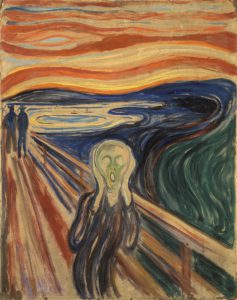 Philosophical and Social Origins of Identity Politics and the LGBTQ Sexual Revolution. Part 2.
Turning and turning in the widening gyre
The falcon cannot hear the falconer;
Things fall apart; the centre cannot hold;
Mere anarchy is loosed upon the world,
The blood-dimmed tide is loosed, and everywhere
The ceremony of innocence is drowned;
The best lack all conviction, while the worst
Are full of passionate intensity.
W.B. Yeats, The Second Coming
A) Loss of meaningful sacred order and providence
Since antiquity, people acknowledged that there is a natural order of law and morals. Life is best lived when it is lived in accordance with the requirements of natural order. Among the Greeks, the Stoics taught that man must live in harmony with the rational and purposive order in nature. Ancient Israel also acknowledged a natural order, one that is implanted into creation by the Creator. According to the sages of ancient Israel, knowledge of God comes from experiencing God’s activity in the world. Faith in God’s providence means trusting in the reliability of the creation which the benevolent God has ordered to support human life and guide man in his moral knowledge and action. Gerhard von Rad explains, “This order [of creation] was, indeed, simply there and could, in the last resort, speak for itself. The fact that it quietly but reliably worked towards a balance in the ceaselessly changing state of human relationships ensured that it was experienced over and over again as a beneficent force. In it, however, Yahweh himself was at work in so far as he defended goodness and resisted evil. It was he who was present as an ordering and upholding will in so far as he gave a beneficent stability to life and kept it open to receive his blessings.”1Gerhard von Rad, Wisdom in Israel (SCM, 1972), pp. 191-192. Continue reading “All that is Solid Melts into Air: The Recentred but Empty Self”
The Vanished Soul and Quest for the Authentic Self in Modern Western Thought
 Philosophical and Social Origins of Identity Politics and the LGBTQ Sexual Revolution. Part 1.
Due to the influence of the Bible, the majority of thinkers in Western society for centuries have acknowledged the reality of the soul which is distinct and yet intimately linked to the body. According to the Christian tradition, what we refer to as body and soul are aspects of one unitary reality and process, that is, the body and soul are viewed as a psychophysical unit, the human person. The physical body changes through time but the soul persists as the person interacts continuously with the world. It is the continuity of the soul, with its faculties of intellect and will, which ensures coherence and defines the personal identity of the person.1Due to constrains of a short article, the words “soul”, “self” and “mind” are used in this post interchangeably in the light of overlaps in their semantic domain. For example, the immortality of the soul is linked to the immateriality of the mind and the mind is a power of the soul. However, we should be sensitive to the nuances of each thinker in how he uses these words.
Knowledge of the soul is inseparable from knowledge of God.2John Calvin notes, “true and sound wisdom, consists of two parts: the knowledge of God and of ourselves. But, while joined by many bonds, which one precedes and brings forth the other is not easy to discern. In the first place, no one can look upon himself without immediately turning his thoughts to the contemplation of God, in whom he “lives and moves”… Again, it is certain that man never achieves a clear knowledge of himself unless he has first looked upon God’s face, and then descends from contemplating him to scrutinize himself.” John Calvin, Institutes of the Christian Religion (Westminster, 1960), Book 1.1.1, 2. However, from the 17th century, many Western scholars and scientists began to reject both the idea of God and the soul. Indeed, the soul has become absent or irrelevant in contemporary intellectual discourse. How did this happen?
To answer this question, we begin with the French philosopher, Rene Descartes. Continue reading “The Vanished Soul and Quest for the Authentic Self in Modern Western Thought”
Confronting Modernity
Criticisms against globalization take many hues. In times of economic crisis, we campaign against unfair trading between rich and poor nations. When western news agencies highlight any political fracas, we protest against the mischievousness of their journalists. When western rock concerts enraptured our youths we sound the clarion call to protect our culture against the corrupting influence of foreign values.
Confronting Modernity: The Cultural Challenge of Globalization
Ng Kam Weng
Criticisms against globalization take many hues. In times of economic crisis, we campaign against unfair trading between rich and poor nations. When western news agencies highlight any political fracas, we protest against the mischievousness of their journalists. When western rock concerts enraptured our youths we sound the clarion call to protect our culture against the corrupting influence of foreign values.
Evidently, critics of globalization attempt to seize the moral high ground, couching their rhetoric in moral terms. Our critics, however, need to go beyond assigning blame and move towards a constructive critique. We should first try to understand why we are lagging behind the more developed nations. This should be followed by cogent analyses of the forces that propel the overwhelming onslaught of globalization, the market mechanism and cultural dynamics that make globalization such an irresistible phenomenon today. We will then be able to formulate a comprehensive response to globalization. Continue reading “Confronting Modernity”