Earlier post – “Cosmos to Cradle: From Pre-existent to Incarnate Christ.”
I. Contemporary Challenges to Christ’s Pre-existence
Several prominent scholars have recently challenged the orthodox doctrine of Christ’s divine pre-existence. This article provides a response to their challenge from the standpoint of historic Christian orthodoxy.
A. John Hick’s Mythological Interpretation
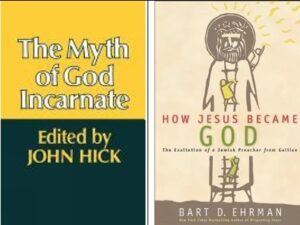
John Hick contends that the doctrine of the Incarnation is not a literal truth but a mythological construct developed by the early Church. In The Myth of God Incarnate, he writes:
I suggest that…the idea of divine incarnation is a mythological idea. And I am using the term ‘myth’ in the following sense: a myth is a story which is told but which is not literally true, or an idea or image which is applied to someone or something but which does not literally apply, but which invites a particular attitude in its hearers. Thus the truth of a myth is a kind of practical truth consisting in the appropriateness of the attitude to its object. That Jesus was God the Son incarnate is not literally true, since it has no literal meaning, but it is an application to Jesus of a mythical concept whose function is analogous to that of the notion of divine sonship ascribed in the ancient world to a king…it offers a way of declaring his significance to the world; and it expresses a disciple’s commitment to Jesus as his personal Lord. He is the one in following whom we have found ourselves in God’s presence and have found God’s meaning for our lives. He is our sufficient model of true humanity in a perfect relationship to God.1The Myth of God Incarnate (SCM, 1977), pp. 178-179.
For Hick, Jesus is not ontologically divine but is a uniquely God-conscious human being whose life invites existential commitment. The Incarnation, in this view, is a symbolic affirmation of Jesus’ exemplary humanity, not a metaphysical reality.
B. Bart Ehrman’s Developmental Theory
Bart Ehrman argues that belief in Jesus’ divinity and pre-existence was not held by His earliest followers but emerged gradually over time. In How Jesus Became God, he writes:
“It will become clear in the following chapters that Jesus was not originally considered to be God in any sense at all, and that he eventually became divine for his followers in some sense before he came to be thought of as equal with God Almighty in an absolute sense. But the point I stress is that this was, in fact, a development. One of the enduring findings of modern scholarship on the New Testament and early Christianity over the past two centuries is that the followers of Jesus, during his life, understood him to be human through and through, not God.”2Bart Ehrman, How Jesus Became God (Zondervan, 2014), p. 44.
Ehrman appeals to the silence of the Synoptic Gospels as evidence that Jesus did not claim to be God and that the divinity of Jesus is a result of later development of Christian dogma, not something originally attributed to Him. He raises a rhetorical question:
I realized that some of the authors of the New Testament do not equate Jesus with God. I had become impressed with the fact that the sayings of Jesus in which he claimed to be God were found only in the Gospel of John, the last and most theologically loaded of the four Gospels. If Jesus really went around calling himself God, wouldn’t the other Gospels at least mention the fact? Did they just decide to skip that part?3Ehrman, pp. 86-87.
Ehrman concludes that the doctrine of Christ’s divinity and pre-existence is an original apostolic belief. It is the result of later theological development of the church.
C. James Dunn’s Adamic Christology
James Dunn in Christology in the Making argues that there was diversity of Christological themes (Son of God, Adam, Wisdom, Word, etc.) in early Christian Christology. There was no uniform or conclusive teaching of Jesus as a pre-existent divine figure, not even in the hymn in Philippians 2:5-11, which is surely one of the most theologically and Christologically significant texts in the New Testament. We cannot miss the great theme of humiliation and exaltation in the hymn, but Dunn argues that the hymn is best understood in Adamic terms:
It seems to me an open question as to whether the hymn contains any thought of pre-existence, other than the pre-existence involved in the paradigm – that is, the metahistorical character of the Adam myth. The point of the hymn is the epochal significance of the Christ-event, as determinative for humankind as the ‘event’ of Adam’s creation and fall, with the question of pre-existence rather more an irrelevance and distraction than a help to interpretation.
Dunn questions whether one could derive Christ’s divine status and pre-existence from the exaltation of Jesus. He asserts,
“Such an assumption seems to ignore completely the fact that in the Judaism of the time several historical figures were being spoken of in terms of exaltation and of exercising functions hitherto attributed to God alone without [emphasis added] similar implications being drawn – for example, Enoch, Elijah, Abel, Moses, and possibly Melchizedek.” Dunn concludes, “I dated the emergence of the Christian doctrine of the incarnation late in the first century CE.”4James Dunn, Christology in the Making, 2nd ed. (SCM, 1980, 1989), pp. x, xx-xxiii.
Dunn concludes that the explicit doctrine of Christ as the pre-existent Word made flesh was not fully developed in the earliest New Testament writings. It was not a first-generation belief. The doctrine emerged gradually and reached its definitive form from the second to fourth centuries when the church defended the deity of Christ against early heresies.
II. Orthodox Defence of Christ’s Pre-existence
A. Douglas McCready’s Defense of Christ’s Pre-existence
The teachings of Hick, Ehrman and Dunn pose a direct challenge to the high Christology held by main stream Christianity for two millennia which affirms that Christ’s pre-existence. Contrary to the critics, pre-existence is not a later theological embellishment but is a foundational truth embedded in the earliest writings of the New Testament. Indeed, the foundational Christological texts such as John 1:1–14, John 17:5, Philippians 2:5–11, Colossians 1:15–17 become unintelligible apart from the affirmation that the eternal Son entered time and took on flesh
Gerald O’Collins gives a succinct explanation of the orthodox view of pre-existence:
“The christological doctrine of pre-existence maintains that Christ’s personal existence is that of an eternal Subject within the oneness of God… He did not come into existence as a new person around 5 BC. He exists personally as the eternal Son of God…Pre-existence means rather that Christ personally belongs to an order of being other than the created, temporal one.” 5Gerald O’Collins, Christology, 2nd ed., OUP, 1995/2009, pp. 248–249.
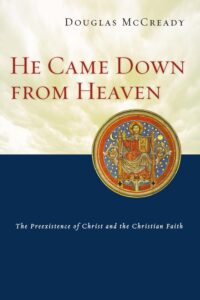
Given below is an outline of Douglas McCready’s defence of Christ’s pre-existence in his book, He Came Down from Heaven. Douglas McCready writes,
“The language of incarnation presupposes Christ’s personal or real preexistence; otherwise there was no one to become incarnate…Incarnation is meaningless apart from the preexistent Christ, and Christ’s preexistence is irrelevant apart from the incarnation of the Son to save us and to reveal God to us. These teachings cannot stand in isolation.”6Douglas McCready HCDFH, p. 14, 26. We shall highlight relevant exegetical notes of several crucial loci classici verses on New Testament Christology along with comments by Douglas McCready’s defense of Christ’s pre-existence.
1. Witness of John
a. John 1:1–18
Note: 1) The phrase ἐν ἀρχῇ – en archē, in the beginning, explicitly places the Logos eternal pre-existence prior to the beginning of the created order. 2) The Word is not created; he is the agent of creation, and therefore both pre-existent and eternal. 3) The declaration “the Word became flesh” (v. 14) can only mean the incarnation of a pre-existing personal subject: a preexistent, person assumes human flesh without ceasing to be who he eternally is. In sum, the Johannine prologue affirms the full deity and eternal existence of the Logos, who became incarnate in Jesus Christ.
McCready writes,
Of the categories John could have chosen for the preexistent Christ, only Word was not part of the created order. Even terms like Wisdom that Jews understood as preexistent were creation, not creator. The Word, however, mediated all creation. This emphasis on the Word’s creative role is important because the incarnate Word came to accomplish God’s re-creation of the world. Of course, it is logically necessary for the Word to have existed before creation if he mediated its coming into being…The Logos of S. John is not a mere attribute of God, but the Son of God existing from all eternity, manifested, in space and time, in the Person of Christ.7McCready, HCDFH, p. 146.
b. John 8:58
Note: 1) “Before Abraham was (came into being, genesthai)” – Abraham had a beginning, a point of coming-into-existence. In contrast, Jesus declares, “I am [egō eimi].” He does not say “I was” (ēn), which would merely express a prior existence in time. Instead, egō eimi suggests timelessness and continuous existence, an existence qualitatively different from Abraham’s. 2) This verse echoes Exodus 3:14—YHWH’s “I AM.” The crowd’s reaction – attempting to stone (John 8:59) – shows they understood it as a claim to divine identity or prerogatives. Thus Jesus claims a mode of existence that predates Abraham in a divine manner, that is, personal preexistence that transcends time. This claim is repeated elsewhere in the Gospel of John (e.g., 1:1–3; 17:5).
Comment: McCready cites Leon Morris who reminds us Jesus said that before Abraham “I am,” not “I was.” George Beasley-Murray agrees, saying Jesus’ words imply a personal preexistence that is possible “because the ‘I’ of Jesus is one with the ‘I’ of the divine Logos.” He adds, “The revelation utterance of v. 58, accordingly, is one with the Logos theology of the prologue in declaring the Son to be the authentic revealer of the Father and his unity with him beyond all time.”8McCready, HCDFH, p. 149.
McCready observes that “neither Robinson nor Dunn denies John taught Christ’s preexistence; one is concerned with whether John taught Jesus’ deity and the other with whether 8:58 and similar verses are authentic words of Jesus.”9McCready, p. 150.
2. Paul’s writings
a. Philippians 2:6–11
Note: 1) Paul affirms that Christ’s pre-existence as Christ was as already existing in divine glory before becoming human. 2) Christ possessed equality with God in his pre-existent state. 3) The transition from Christ existing in the “form of God” (morphē theou) to the “form of a servant” presupposes Christ’s pre-existence.
Comment: McCready summarizes after reviewing various scholars including James Dunn, Ralph Martin and Gordon Fee:
The hymn tells chronologically the story of one who possessed the essence of deity but did not let his divine status interfere with God’s salvific plan. Instead, he entered into human existence and suffered the extreme humiliation of being rejected and killed by those he had come to save. For this great selflessness God glorified him by publicly identifying him as deity so he might receive the honor due to God alone. Such a one was necessarily a preexistent person because the Bible nowhere allows for humans to be exalted as deities in their own right, and the Jesus of Philippians 2:6-11 certainly is designated as deity. Attempts to show that the apparent meaning of the passage cannot be the real meaning have been completely unsuccessful. Silva notes that although the passage may not intend an ontological description of Christ, it nonetheless reflects an ontological interpretation of Christ.10McCready, HCDFH, p. 80.
b. Colossians 1:15–20
Note: Christ is portrayed as the agent and goal of creation, emphasizing his divine, pre-temporal identity: 1) The phrase “he is before all things” affirms Christs’ pre-existence identity. The “image of the invisible God” (εἰκὼν τοῦ θεοῦ – eikōn tou theou) points to Christ as the eternal manifestation of God, not a created being. 2) Paul distinguishes Christ from creation itself, and the title “Firstborn of all creation” (πρωτότοκος πάσης κτίσεως – prōtotokos pasēs ktiseōs) carries the meaning of supreme rank of Christ as the agent, goal and sustainer of all creation. The divine work of creation necessarily entails Christ’s is pre-existence and supremacy over creation.
McCready elaborates,
This passage describes Christ in exalted terms. He does not exist in or after the image of God, he is the image of God.” He perfectly represents God. He created all that is and now sustains all that has been created. He has reconciled the world to God, and is supreme over the created order. For this to be true, he necessarily preexisted the created order. No other interpretation makes any sense. The antecedent to this opening “he” is found in verse 13, where Paul writes of the Son of God “in whom we have redemption, the forgiveness of sins.”11McCready, HCDFH, p. 82.
He concludes,
This Colossians passage presents Christ as one who both was the image and fullness of God and acted in ways other biblical passages attribute only to God. As the mediator of creation, he necessarily preexisted it. Assuming the fullness of deity includes the divine attributes, Christ is eternal. The passage describes one who shares the divine nature and enjoys eternal preexistence, who is in fact God. The objections raised have not overturned this testimony of the passage.12McCready, HCDFH, p. 86.
3. Book of Hebrews
a. Hebrews 1: 1-8
Note: 1) The Son is described as the radiance of God’s glory. “Radiance” (ἀπαύγασμα – apaugasma) signifies the outshining or emanation of divine glory. The Son possesses the same divine glory eternally and intrinsically. 2) “The exact imprint of his being” (χαρακτὴρ τῆς ὑποστάσεως – charaktēr tēs hypostaseōs) points to correspondence and identity of essence between the Son and God, that is, the Son shares God’s full divine reality. 3) If the Son shares God’s intrinsic glory and full divine essence, it follows that he possesses eternal existence. He is pre-existent and distinct from all creation, including angels. 4) Finally, The exaltation of Christ is the restoration of the glory he possessed prior to his incarnation.
Comment: McCready writes,
This passage…is the key text in Hebrews dealing with Christ’s-preexistence, both because it introduces the entire book and because of the clarity of its language. It associates the Son explicitly with God in language that appears ontological and connects with his preexistence his work of atonement, mediation and sustainment, and his postexistence. I believe it requires we assume the Son’s preexistence based on his role in creation and the sending statement. Both the ascription to the Son of the name God and the expectation that the angels will worship the Son mean we should understand this Son in terms of his deity. The descriptions of the Son as the radiance of God’s glory and the exact representation of his being also present the Son in terms of deity.” 13McCready, HCDFH, p. 128.
“As the mediator of creation it is necessary that the Son existed prior to that creation. To say God brings his firstborn into the world can only mean he existed prior to being brought into the world. To be worthy of worship and addressed as God require the Son’s deity and thus presume his preexistence. To designate this preexistence as ideal is to ignore the clear sense of the passage.”14McCready, HCDFH, pp. 129.
4. Summary
a. McCready summarizes:
In every instance the New Testament authors’ mention of Christ’s preexistence was integral to their message that Christ came to accomplish our salvation. Preexistence was not for them an item of theological speculation. No New Testament author wrote as if this teaching were anything other than a well-established belief among his readers; instead, they used this widely held belief in order to argue for some controversial teaching. That he was the Son of God who had come from heaven provided the ontological justification for Christ’s functional accomplishments. John understood this most clearly and intimately because he had been a member of Jesus’ inner circle.15McCready, HCDFH, p. 161.
b. McCready’s logical argument for the pre-existence of Christ may be laid out as follows:
Salvation is the work of God alone and therefore requires the intervention of the Creator himself. This intervention took the form of the incarnation of the Son who was sent from above to enter creation and assumed human nature. That is to say, if salvation is God’s work alone, and Christ is the one who accomplishes salvation, then Christ must be God who pre-existed before his earthly life. Thus, Christ’s pre-existence is not a theological speculation; it is the foundation of the Incarnation and the basis for salvation.
B. Conclusion
McCready ends with a two-fold defence of Christ’s pre-existence:
1. Negatively: “What would be the result if the prior eternity of Christ were invalidated? Simply that the Christian faith as we know it would cease to exist. Without the preexistent Son entering time there would be no Trinity. The God of the Bible and the church would vanish. Deny Christ’s prior existence and there would be no incarnation of the Word. Negate preexistence and there would be no ultimate revelation of the Father…For good reasons, then, the eternal existence of Jesus Christ has been upheld as a key doctrine of Christianity.16McCready is citing from Brian Hebblethwaite, “The Appeal to Experience in Christology,” in Christ, Faith and History” in Christ, Faith and History, ed. S. W. Sykes and J. P. Clayton (CUP, 1972), p. 264.
2. Positively: The Christian doctrine of Christ’s preexistent deity confirms the glory of God’s love and justifies the consolation and confidence of Christians. It says God so loved the world that he sent his only begotten Son to save it. It should elicit from us thanksgiving, worship and commitment. p. 317.
Reference Text
Douglas McCready, He Came Down from Heaven (IVP, 2005). HCDFH.
Related Post
Cosmos to Cradle: From Pre-existent to Incarnate Christ.