[responsivevoice_button]
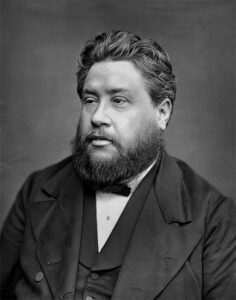
Free-Will – A Slave
“And ye will not come to me, that ye might have life.”—John 5:40
Excerpt from Spurgeon’s Sermon: Free Will—A Slave
IV. This brings us to the fourth point, THAT BY NATURE NO MAN WILL COME TO CHRIST,
It is true of all men in their natural condition that they will not come unto Christ.
The Son of God came, yet men rejected him. “Ye will not come to me that ye might have life.” It would take too much time to mention any more Scripture proofs. We will, however, refer to the great doctrine of the fall. Any one who believes that man’s will is entirely free,1Clarification – Spurgeon has earlier contrasted “Free will” with “Free Agency”, stating, “Free agency we may believe in, but free-will is simply ridiculous. The will is well known by all to be directed by the understanding, to be moved by motives, to be guided by other parts of the soul, and to be a secondary thing. Philosophy and religion both discard at once the very thought of free-will; and I will go as far as Martin Luther, in that strong assertion of his, where he says, “If any man doth ascribe aught of salvation, even the very least, to the free-will of man [paraphrase – If anyone credits human free will with any part of their salvation, even the smallest amount], he knoweth nothing of grace, and he hath not learnt Jesus Christ aright.” and that he can be saved by it, does not believe the fall.
…Your fallen nature was put out of order; your will, amongst other things, has clean gone astray from God. But I tell you what will be the best proof of that; it is the great fact that you never did meet a Christian in your life who ever said he came to Christ without Christ coming to him. You have heard a great many Arminian sermons, I dare say; but you never heard an Arminian prayer – for the saints in prayer appear as one in word, and deed and mind. An Arminian on his knees would pray desperately like a Calvinist. He cannot pray about free-will: there is no room for it. Fancy him praying,
Lord, I thank thee I am not like those poor presumptuous Calvinists Lord, I was born with a glorious free-will; I was born with power by which I can turn to thee of myself; I have improved my grace. If everybody had done the same with their grace that I have, they might all have been saved. Lord, I know thou dost not make us willing if we are not willing ourselves. Thou givest grace to everybody; some do not improve it, but I do. There are many that will go to hell as much bought with the blood of Christ as I was; they had as much of the Holy Ghost given to them; they had as good a chance, and were as much blessed as I am. It was not thy grace that made us to differ; I know it did a great deal, still I turned the point; I made use of what was given me, and others did not-that is the difference between me and them.
That is a prayer for the devil, for nobody else would offer such a prayer as that. Ah! when they are preaching and talking very slowly, there may be wrong doctrine; but when they come to pray, the true thing slips out; they cannot help it. If a man talks very slowly, he may speak in a fine manner; but when he comes to talk fast, the old brogue of his country, where he was born, slips out. I ask you again, did you ever meet a Christian man who said, “I came to Christ without the power of the Spirit?” If you ever did meet such a man, you need have no hesitation in saying, “My dear sir, I quite believe it-and I believe you went away again without the power of the Spirit, and that you know nothing about the matter, and are in the gall of bitterness and the bond of iniquity.” Do I hear one Christian man saying, “I sought Jesus before he sought me; I went to the Spirit, and the Spirit did not come to me”? No, beloved; we are obliged, each one of us, to put our hands to our hearts and say-
“Grace taught my soul to pray,
And made my eyes to o’erflow;
‘Twas grace that kept me to this day,
And will not let me go.”
Is there one here—a solitary one—man or woman, young or old, who can say, “I sought God before he sought me?” No; even you who are a little Arminian, will sing—
“O yes! I do love Jesus—
Because he first loved me.”
Source:
Free-Will – A Slave
Charles Haddon Spurgeon December 2, 1855 Scripture: John 5:40 From: New Park Street Pulpit Volume 1
Related Post:
A Calvinist Critique of Arminian Hermeneutics of Election and Salvation