Universalism = Christ Died for the sins of all people without exception
I. John Owen, in The Death of Death in the Death of Christ (1648), offers a classic defence of definite atonement—the doctrine that Christ’s death was both definite in purpose and effective in accomplishment. Christ died not for humanity in general, but specifically for the elect whom the Father had given him; and his death actually secured their redemption.
Owen advances two powerful arguments in defence of this position.
The Double Payment Argument
Sin is a debt owed to God’s justice. Christ’s death has fully paid the penalty for sin. If Christ died for all people universally, then all must be saved, because a just creditor does not demand payment for the same debt twice. Exacting double punishment—first on Christ, then on the condemned sinner—is unjust. Yet Scripture clearly teaches that not everyone is saved. Therefore, Christ did not die for all people universally, and his atoning work was intended only for the elect – This is an argument to the contrary. (John Owen, The Works of John Owen, Goold ed. [Banner of Truth reprint, 1989], vol. 10, p. 173. All subsequent citations refer to this edition.)
The Universalist Dilemma
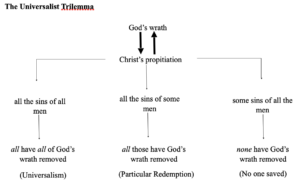
Owen then challenges the universalist claim that Christ died for every individual human being. He argues that this position entails one of three possibilities: Christ bore (1) all the sins of all people, (2) some of the sins of all people, or (3) all the sins of some people. Option (1) entails universal salvation, which contradicts Scripture. Option (2) means every person still stands condemned for their remaining sins. Only option (3) is logically coherent and scripturally grounded. Owen concludes that Christ died for all the sins of the elect alone.
1. The Arminian Objection: The “Commercial Model”
Arminian critics argue that Owen’s account of the atonement amounts to a rigid “commercial model” in which salvation is likened to an impersonal commercial transaction. On their view, this model carries several problems. First, it undermines the universal significance of Christ’s death, since commercial transactions are by nature restricted to the contracting parties. Second, and more seriously, Owen allegedly fails to distinguish between the provision of atonement and the requirement of faith to appropriate it.
Arminians insist that Christ’s death is sufficient for all, but effective only for those who believe. Payment is not automatically credited; it must be received through faith. To use their analogy: Christ’s atonement is like a cheque sufficient to pay the debt of all humanity, but it only takes effect when someone accepts and deposits it by faith. If a person refuses, their debt of sin remains unpaid. On this account, Owen’s double-payment concern does not arise, because unbelievers never accept the benefit of Christ’s payment.
It is true that Owen employs the language of debt and payment. He describes sin as a debt owed to divine justice and Christ as the surety who pays it on behalf of the elect:
To whom any thing is due from any man, he is in that regard that man’s creditor; and the other is his debtor, upon whom there is an obligation to pay or restore what is so due from him, until he be freed by a lawful breaking of that obligation, by making it null and void; which must be done by yielding satisfaction to what his creditor can require by virtue of that obligation. (Owen, p. 265)
Owen also writes:
That the debt thus paid was not this or that sin, but all the sins of all those for whom and in whose name this payment was made, 1 John 1:7…That a second payment of a debt once paid, or a requiring of it, is not answerable to the justice which God demonstrated in setting forth Christ to be a propitiation for our sins, Rom. 3:25. (Owen, pp. 272–273)
2. The Commercial Model Objection Answered
The Arminian rebuttal rests on a caricature of Owen’s position. Owen never intends his debt-and-payment language as a literal description of a bookkeeping transaction between Christ and God. Rather, he employs these terms as conceptual tools to illuminate the requirements of penal satisfaction to divine justice. The “debt” in question is always a “debt of sin” that must be answered for before God’s righteous standard.
Central to Owen’s framework is the figure of Christ as legal surety—one who offers a legally binding guarantee to discharge the debt or moral obligations of another who has failed (sinned). Owen writes:
If Jesus Christ paid into his Father’s hands a valuable price and ransom for our sins, as our surety, so discharging the debt that we lay under, that we might go free, then did he bear the punishment due to our sins, and make satisfaction to the justice of God for them. (Owen, pp. 266, 281)
For Owen, the atonement is not primarily a commercial exchange but a transfer of penal consequences—suffering and death borne on behalf of sinners—resulting in a real and effective satisfaction of divine justice: “To make an atonement for sin, and to reconcile God unto the sinners, is in effect to make satisfaction unto the justice of God for sin.” He elaborates:
It was a full, valuable compensation, made to the justice of God, for all the sins of all those for whom he made satisfaction, by undergoing that same punishment which, by reason of the obligation that was upon them, they themselves were bound to undergo. (Owen, pp. 269, 282)
Furthermore, to assign Owen’s debt-credit metaphor such a defining role of his doctrine is to ignore the full range of his discussion. He also employs the language of ransom, sacrifice, propitiation, redemption, and reconciliation. . Alongside commercial and juridical imagery, Owen also appeals to biblical categories such as sacrifice, ransom, reconciliation, and covenant. These are not reducible to a single controlling metaphor. Seen in this light, the “commercial model” critique oversimplifies Owen’s position. It mistakes one strand of his language for the whole of his theological architecture.
The debt metaphor functions as a subsidiary analogy within a broader legal and covenantal framework. In fact, the deeper structure of Owen’s thought is better described as covenantal rather than commercial: Christ, as surety, assumes the obligations of his people before God. This comes through clearly in the following passage:
The proper counsel and intention of God in sending his Son into the world to die was, that thereby he might confirm and ratify the new covenant to his elect, and purchase for them all the good things which are contained in the tenure of that covenant—to wit, grace and glory; that by his death he might bring many (yet some certain) children to glory, obtaining for them that were given unto him by his Father… reconciliation with God, remission of sins, faith, righteousness, sanctification, and life eternal. (Owen, p. 90)
The controlling category here is not commercial equivalence but covenantal intention: Christ died to accomplish the role given to him in the covenant of redemption between the Father and the Son. The atonement is effective precisely because it is specific and intentional.
3. Owen’s Distinction Between Impetration and Application
Arminian critics also assert that Owen fails to distinguish between the accomplishment of atonement (what Owen calls “impetration”) and its application to individual believers. They press their point by asking, “If Christ paid for all the sins of the elect, why are they not all saved automatically?” This objection, however, however, does not hold up under close examination.
Owen explicitly upholds the distinction between impetration and application:
We, according to the Scriptures, plainly believe that Christ hath, by his righteousness, merited for us grace and glory; that we are blessed with all spiritual blessings, in, through, and for him…that he hath procured for us, and that God for his sake bestoweth on us, every grace in this life that maketh us differ from others, and all that glory we hope for in that which is to come; he procured for us remission of all our sins, an actual reconciliation with God, faith, and obedience. (Owen, p. 93)
Crucially, Owen holds that Christ’s death not only procured remission of sins but also secured the very means of its application—faith and obedience—for those on whose behalf he died. Owen clearly maintains that what Christ achieves in his death (impetration) is applied in time through the work of the Spirit (application). The crucial point, however, is that he refuses to separate these two aspects too sharply. For Owen, Christ does not merely make salvation possible; he secures everything necessary for its realization, including the faith by which it is received.
The difference between Owen and Arminians is unmistakable. For Owen, Christ does not merely make salvation possible; he accomplishes all that is necessary for its realization, including the very faith by which it is received. Christ’s work of atonement is truly complete since Christ’s sacrifice procures both the remission of sins and the faith that embraces it. Consequently, the salvation of those for whom Christ specifically died is guaranteed. D.A. Carson expresses the same confidence when he writes, “God’s saving purposes cannot be thought to be frustrated. Jesus’ confidence does not rest in the potential for positive response amongst well-meaning people. Far from it: his confidence is in his Father to bring to pass the Father’s redemptive purposes: All that the Father gives me will come to me. Jesus’ confidence in the success of his mission is frankly predestinarian.”1D.A. Carson, The Gospel according to John (Eerdmans, 1991), p. 290.
4. Christ’s Personal Intercession in Owen’s Atonement
Arminian critics charge Owen with teaching an impersonal atonement. This objection collapses upon reading Owen’s extensive treatment of Christ’s intercessory work, which Owen regards as inseparable from his sacrificial offering (oblation). Owen writes:
The oblation of Christ is the foundation of his intercession, and his intercession the oblation perfected. Now, that these two are of equal compass and extent in respect of their objects, is most apparent. He intercedes for all, and only for those, for whom he offered himself: and for them he intercedes that the good things procured by his oblation may be bestowed upon them… and maketh continual intercession with this intent and purpose, that all the good things so procured by his death might be actually and infallibly bestowed on and applied to all and every one for whom he died. (Owen, p. 181)
This is confirmed by Hebrews 7:25: “Consequently, he is able to save to the uttermost those who draw near to God through him, since he always lives to make intercession for them.” Far from being impersonal, Owen’s account of the atonement culminates in the living Christ personally interceding for each of his elect before the Father.
In summary, the Arminian critique reduces Owen’s doctrine to a caricature. Owen never teaches that the benefits of salvation accrue apart from faith; his atonement is a comprehensive salvific work encompassing both objective accomplishment and subjective application. The double-payment concern does not arise for unbelievers because Christ never died for them.2David Allen’s recent work on the extent of the atonement misses the focus of Owen’s logic when he conflates sufficiency with intent and ignores the covenant which serves as the controlling framework of Owen’s theology of the atonement. The charge of impersonalism ignores Owen’s rich treatment of Christ’s ongoing intercession on behalf of his people, which he considers the necessary complement and continuation of Christ’s atoning sacrifice.
II. The Universalist Dilemma
[Universalism = Christ died for all people without exception]
Having defended definite atonement against Arminian objections, Owen moves from defence to offence, pressing a dilemma against those who affirm universal atonement. He begins from the scriptural premise that God laid the sins of his people upon Christ: “All we like sheep have gone astray; we have turned everyone to his own way; and the LORD hath laid on him the iniquity of us all” (Isaiah 53:6).3Owen’s full exposition of the Universalist Dilemma is given in Owen, pp. 173-174
Owen finds it deeply problematic that Christ should undergo the pains of hell in place of those who were already enduring those pains before he suffered, and who will continue in them forever—for “their worm dieth not, neither is their fire quenched.” He then poses the following trilemma to universalists:
Universalism = Christ Died for the sins of all people without exception
The question is: whose sins did God place upon Christ? Three answers are possible:
a) All the sins of all people (universally, without exception)
b) All the sins of some people (the elect, without distinction), or
c) Some sins of all people.
Owen works through each option in turn.
Option (c): Some Sins of All People
If Christ bore only some sins of all people, then every person still has sins remaining for which they must answer. Since even a single sin is sufficient to be condemned—“If the LORD should mark iniquities, who could stand?” (Psalm 130:3)—no one would be saved. This option is immediately self-defeating.
Option (b): All the Sins of Some People
This is Owen’s own position: Christ bore the full guilt of the elect in their place, and his death effectively secured their salvation. This is the only option that is both logically coherent and scripturally grounded.
Option (a): All the Sins of All People
This is the universalist claim. If Christ bore all the sins of all people, the obvious question is: why is not everyone freed from punishment? The standard Arminian answer is that unbelief prevents the application of Christ’s atonement.
But Owen presses the point: is unbelief itself a sin? If it is not, then there is no ground for punishing anyone on account of it. If it is a sin—which Scripture plainly teaches—then either Christ bore its punishment or he did not. If he did, then unbelief cannot prevent salvation any more than any other sin he atoned for. If he did not, then Christ did not die for all sins after all, and the universalist claim is self-contradictory.
As Owen puts it:
You will say, ‘Because of their unbelief; they will not believe.’ But this unbelief, is it a sin, or not? If not, why should they be punished for it? If it be, then Christ underwent the punishment due to it, or not. If so, then why must that hinder them more than their other sins for which he died from partaking of the fruit of his death? If he did not, then did he not die for all their sins. Let them choose which part they will. (Owen, pp. 173–174)
Universalism collapses under its own internal contradictions. In short, Owen’s “Universalist dilemma” forces Arminians to choose either universal salvation or logical incoherence. Only definite atonement—Christ dying for all the sins of the elect—is able to preserve both the justice of God and the plain teaching of Scripture that many remain condemned.
Earlier posts in the current series.
1) A Calvinist Critique of Arminian Hermeneutics of Election and Salvation.
2) Definite (Limited) Atonement and Particular Redemption through Christ’s Death in Pauline Theology. Part 1/2.
3) Definite (Limited) Atonement and Particular Redemption through Christ’s Death in Pauline Theology. Part 2/2.
4) The Arminian Conversion Prayer.
5) “Regeneration Precedes Faith”. An AI-assisted Calvinist Rebuttal to Arminian David Allen’s Analysis of Key Verses in 1 John.
Related posts
Definite Atonement (Part 1/3): Engaging Arminian Proof Texts for Universal Atonement (Links to additional related posts at given at the end of the article).