Answering Contemporary Academic Challenges to Christ’s Divine Pre-existence

Earlier post – “Cosmos to Cradle: From Pre-existent to Incarnate Christ.”

I. Contemporary Challenges to Christ’s Pre-existence
Several prominent scholars have recently challenged the orthodox doctrine of Christ’s divine pre-existence. This article provides a response to their challenge from the standpoint of historic Christian orthodoxy.

A. John Hick’s Mythological Interpretation
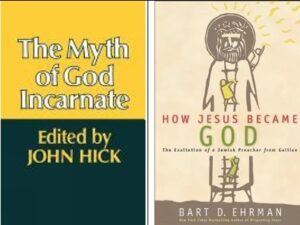
John Hick contends that the doctrine of the Incarnation is not a literal truth but a mythological construct developed by the early Church. In The Myth of God Incarnate, he writes:

I suggest that…the idea of divine incarnation is a mythological idea. And I am using the term ‘myth’ in the following sense: a myth is a story which is told but which is not literally true, or an idea or image which is applied to someone or something but which does not literally apply, but which invites a particular attitude in its hearers. Thus the truth of a myth is a kind of practical truth consisting in the appropriateness of the attitude to its object. That Jesus was God the Son incarnate is not literally true, since it has no literal meaning, but it is an application to Jesus of a mythical concept whose function is analogous to that of the notion of divine sonship ascribed in the ancient world to a king…it offers a way of declaring his significance to the world; and it expresses a disciple’s commitment to Jesus as his personal Lord. He is the one in following whom we have found ourselves in God’s presence and have found God’s meaning for our lives. He is our sufficient model of true humanity in a perfect relationship to God.1The Myth of God Incarnate (SCM, 1977), pp. 178-179.

For Hick, Jesus is not ontologically divine but is a uniquely God-conscious human being whose life invites existential commitment. The Incarnation, in this view, is a symbolic affirmation of Jesus’ exemplary humanity, not a metaphysical reality.

B. Bart Ehrman’s Developmental Theory
Bart Ehrman argues that belief in Jesus’ divinity and pre-existence was not held by His earliest followers but emerged gradually over time. In How Jesus Became God, he writes: Continue reading “Answering Contemporary Academic Challenges to Christ’s Divine Pre-existence”


  • 1
    The Myth of God Incarnate (SCM, 1977), pp. 178-179.

Genesis 1–11: God’s Design for Civilization (Pt. 3/5)

Genesis 1–11: God’s Design for Civilization (Pt. 3/5) Creation Mandate 

Creation Mandate

God’s purpose for humanity is expressed in the Creation Mandate. Understood in context, it is to turn the rest of the earth outside Eden into Eden. It involves building a global civilization that is in fellowship with God and consistent with his will. After sin came into the world and humanity was driven out of Eden, the mandate could no longer be fulfilled as intended. The mandate was derailed but not defeated because God cannot be defeated. Through Christ the Creation Mandate is reclaimed so that it will be fulfilled as intended. This is seen in the Great Commission, which is about making disciples of all nations so that they observe everything Christ has commanded in every aspect of their life (a global civilization consistent with God’s will); and Christ is with disciples of all nations through the Spirit (a global civilization in fellowship with God). It is crucial to recognize that the Great Commission is the renewed Creation Mandate. For it means disciples of Christ cannot dichotomize the spiritual from the secular in any aspect of their life—a problem that has been plaguing modern Christianity.

You can view the full video at
Genesis 1–11: God’s Design for Civilisation (Pt. 3/5) Creation Mandate

What is Worship? Theological and Liturgical Outline

In response to my post, “Loud Music in Worship?”, one question invariably arises: What is worship? The following outline seeks to provide a balanced account of God-centred, holistic Christian worship, integrating theology, liturgy, and lived response.

A. What is worship?
Ralph Martin defines worship as: the dramatic celebration of God in his supreme worth in such a manner that his ‘worthiness’ becomes the norm and inspiration of human living.

Worship is heart-occupation with Christ. Worship is the overflow of the heart that has no request to make. To worship God is to quicken the conscience by the holiness of God; to feed the mind with the truth of God, to purge the imagination by the beauty of God, to open the heart to the love of God, to devote the will to the purpose of God. (William Temple)

Worship is the activity of the new life of the believer in which recognizing the fullness of the Godhead as it is revealed in the person of Jesus Christ and His mighty redemptive acts, he seeks by the power of the Holy Spirit.  Biblical worship is holistic as it is centred on the Triune God and it ministers to the whole person. to render to the living God the glory, honor, and submission which are His due. (Robert Rayburn)

Biblical worship is therefore holistic: It is Trinitarian, Christ-centred, and directed to the whole person’ s mind, will, affections, and body.

Continue reading “What is Worship? Theological and Liturgical Outline”

Van Dyke’s “Joyful Joyful We Adore Thee” is (Religious) Universalistic. A Rejoinder

I have already left behind my thoughts on van Dyke’s hymn posted several days ago & moved on to other issues. Re: Loud Music in Church Worship? However I received two challenges to my understanding of van Dyke’s hymn.

Both essentially argue that I am unjustifiably over-reading & attributing universalistic elements (“eisegesis rather than exegesis!”). Even if it is granted that my theological “rebuttals” in content are correct BUT “there is no such intent in this case. If you assume Van Dyke wrote this with the intention that it be sung by believers, everything is pretty sound.”

My Response:
First, I am not legislating whether someone may or may not sing van Dyke’s hymn. Continue reading “Van Dyke’s “Joyful Joyful We Adore Thee” is (Religious) Universalistic. A Rejoinder”