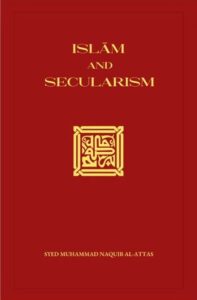
 This post was added as a supplement to the earlier post A Corrective to Syed Muhammad Naquib al-Attas’ Misreading of Aquinas’ Philosophy in his Book, “Islam and Secularism” in Feb. 2026
—–
Naquib al-Attas’ claim that Thomas Aquinas’s misguided distinction between existence and essence led to the development of nominalism, which in turn was responsible for the rise of secularism, is not only philosophically dubious but is also an oversimplification of intellectual history. His argument presents a linear, mono cause-and-effect narrative that fails to account for the complex, multi-causal factors that drove secularization in Europe. While nominalism did play a significant role in this process, it was one influence among many. Political changes, economic shifts (urbanization which severed the relationship between the migrant workers and the village church and parson), the Reformation, Renaissance humanism, and the religious wars of the sixteenth century all contributed crucially to the rise of secularism.
Nominalism and the Erosion of Scholastic Metaphysics
That nominalism helped initiate the conditions for secularism is difficult to deny. By rejecting universals, nominalism undermined the metaphysical foundations of scholasticism and drove a wedge between faith and reason. This represented a significant philosophical shift: abstract metaphysics gave way to a focus on empirical particulars, and theology gradually lost the rational scaffolding that had long legitimized it. In doing so, nominalism opened intellectual space for autonomous science and philosophy to develop independently of religious authority. It was not the cause of secularism, but it was a significant philosophical catalyst that eroded scholasticism from within and indirectly supported secular tendencies by separating faith from reason.
Renaissance Humanism and the Cultural Turn
No less significant was the contribution of Renaissance humanism. The revival of classical texts — particularly those of Lucretius, Cicero and Aristotle — shifted intellectual focus away from divine universals and toward human dignity, civic life, and worldly concerns. Scholars and universities began embracing humanist and secular frameworks, making secular learning respectable across art, literature, and politics. This cultural turn celebrated human agency and elevated the importance of life in the world, creating fertile ground for a broader shift away from religiously dominated thought. Where nominalism provided the philosophical conditions for secular thinking, humanism supplied the cultural and social momentum — celebrating human agency and worldly life in ways that made secularism not merely thinkable, but desirable.
Religious Warfare and the Political Institutionalization of Secularism
The process of secularization was further accelerated by the devastating religious wars of sixteenth-century Europe. The Peace of Augsburg in 1555, which ended the conflict between Catholics and Lutherans through the compromise principle of cuius regio, eius religio (whose realm, his religion), fragmented the authority of a single, authoritative church. No longer could one religious institution claim the exclusive right to legitimize and enforce religious truth across the whole of Christendom. This fragmentation deepened further with the Peace of Westphalia in 1648, which ended the Thirty Years’ War by recognizing the legal equality and territorial integrity of states, reducing the power of the Holy Roman Emperor, and significantly weakening the Roman Catholic Church’s monopoly over public life. In tacitly accepting religious pluralism, Westphalia institutionalized a separation of church and state, embedding secularism directly into the political institutions of Europe.
Conclusion
Taken together, these developments reveal that secularism was not the product of any single philosophical error or intellectual trend but emerged from the convergence of multiple forces. Nominalism and humanism represented two complementary pathways — one philosophical, one cultural — that converged during the Renaissance and went on to fuel the Reformation (an allegation that is seriously challenged by some historians) and Enlightenment. These intellectual currents were then reinforced and institutionalized by the political consequences of religious warfare. Nominalism’s separation of faith from reason and humanism’s celebration of human agency together formed the primary philosophical and cultural catalysts that, in combination with broader political and historical developments, created the conditions in which secularism could take root and flourish.
Related Post
The Primacy of “Existence” over “Essence”: A Foundational Principle of Christian “Existential” Philosophy