Creation as Divine Manifestation. Wahdat al-Wujūd. PCG 3/4
Its Central Teachings and a Christian Critique
A. Introduction
Wahdat al-wujūd (WW), the “Unity of existence,” or “Oneness of Being,” represents one of the most sophisticated and controversial metaphysical frameworks within Islamic Sufism. Primarily attributed to the Andalusian mystic and philosopher Ibn Arabi (d. 1240), this doctrine posits that only God (Allah) possesses true existence (wujūd), and that the phenomenal universe is merely a reflection or manifestation of the Divine Attributes. The philosophy reached Southeast Asia during the 16th and 17th centuries through trade routes connecting the Middle East to Aceh. Hamzah Fansuri (d. 1527) and Shamsuddin al-Sumatrani (d. 1630) adapted Ibn Arabi’s metaphysical framework to reconcile God’s absolute oneness with the visible multiplicity of the world. The premier Malaysian philosopher Naquib al-Attas has defended the orthodoxy of Hamzah Fansuri, distinguishing WW from pantheism while integrating its metaphysics to ground his broader project of establishing the Islamic worldview.
This article examines WW’s core teachings as propounded by Hamzah Fansuri and Naquib al-Attas, exploring their ontological foundations, cosmological framework, and mystical implications, and ending with a Christian theological critique of WW. I shall quote liberally from the works of Naquib al-Attas since many Christians are not familiar with his works.
B. The Ontological Foundation: Wujūd as Fundamental Reality
The ontological foundation of Hamzah’s and Naquib’s philosophy rests on the principle that God alone possesses absolute existence. This doctrine, known as aṣālat al-wujūd (the primacy of existence), asserts that existence (wujūd) is not merely an abstract philosophical concept but the very essence of reality. Naquib draws on recent scholars who defend Avicenna’s insight that existence precedes essence, affirming that what we commonly call “essence” (māhiyyah or quiddity) is merely a mode or accident of wujūd. The only truly self-subsistent reality with necessary existence is God, the Wujūd al-Ḥaqq.
This ontological framework establishes a fundamental distinction between God and all other existents. God exists necessarily and depends on nothing outside himself for his existence. All other existents—the concrete, singular realities of creation—derive their existence from the Necessary Being. Before God brings the universe into existence, the potential forms and realities of all things exist eternally in His consciousness as al-a’yān al-thābitah (Fixed Essences). These eternal archetypes or latent realities represent all possibilities of manifestation that God eternally knows. “Structurally, each eternal Archetype is considered to be the zâhir or “exterior” of particular divine Name which is the bâtin or “interior” of the Archetype. The eternal Archetypes are to be regarded as ontological models which are eternally established in divine Consciousness and upon which the phenomenal things are produced in the empirical dimension of time and space.” See diagram below.1Toshihiko Izutsu, The Concept and Reality of Existence, IBT, 2007, reprint of Keio University 1971 edition, p. 83. Aḥadiyyah the level of God’s Absolute Oneness with his unmanifested Essence. Waḥidiyyah is level of Divine Unity where God’s oneness is manifested through His diverse names and attributes.
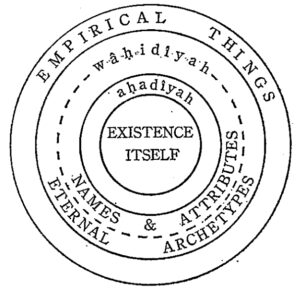
When God issues his creative command to bring the world into being, he manifests these Fixed Essences into the physical realm. Because they exist eternally in the divine mind, creation did not emerge from a void where nothing previously existed.
The cosmos, therefore, is a dependent reflection of God rather than an independent reality. It is neither created nor uncreated in the conventional temporal sense. The Fixed Essences serve as the bridge between God’s absolute oneness and the physical, multi-faceted world. The cosmos is not a separate reality but rather the self-manifestation (tajallī) of the Divine Names and Attributes in the forms of possible things. The manifestation of the Fixed Essences is the unfolding of unity expressed into a multiplicity of modes and grades of existence.2Put succinctly, the Divine Attributes are the inherent perfections of God’s hidden Essence, Divine Names are those attributes in relation to creation, and Fixed Entities are the eternal, individual blueprints of creation known within God’s mind. Because the multiplicity of existents is eternally grounded in the divine knowledge, they cannot be described simply as created or uncreated in merely temporal sense.
C. The Cosmological Framework: Five Stages of Determination
WW elucidates the relationship between God and creation using the analogy of the ocean and waves. A wave appears to have its own form, but it is nothing other than the ocean water. The wave, in and of itself, is “nothing” without the ocean. However, existents are not to be identified with the Divine Essence or with God himself. WW insists that the unity of existence does not abolish the Creator-creation distinction; rather, creation is understood as God self-disclosure in innumerable forms, just as a single ocean reveals itself in various waves. The universe and all within it do not possess an independent, standing existence alongside God. Al-Attas cites Hamzah Fansuri:
“For Hamzah the ‘relationship’ between God and the Universe is merely metaphorical. Since God alone is the only Reality, how can there be a relationship? But God is not identical with the Universe, We predicate of Him transcendence (tanzīh) and immanence (tashbīh) in respect of the predispositions (shu’un) we attribute to His Being. The Universe is a reflection of the predispositions of His Being—it is the effects (āthār) of His creative activity (shu’un). Hence it is said that:
That which we perceive, whether outwardly or inwardly, all disappear—they are as waves. The ocean is not ‘separate’ from its waves, and the waves are not ‘separate’ from the ocean. In like manner, God, Glorious and Most Exalted is not ‘separate’ from the World. But He is neither ‘in’ the world nor ‘outside’ it; neither ‘above’ nor ‘below’ it; neither to the ‘right’ nor to the ‘left’ of it; neither in ‘front’ of nor ‘behind’ it; neither ‘separate’ from nor ‘joined’ to it…” [MHF 67-68]
As waves ebb and flow, creation is not a one-time event that took place in the past but a dynamic process of constant renewal occurring at every single moment. Hamzah Fansuri further explains why the universe, as a manifestation of eternal Fixed Essences, is inconsistent with the idea of creation ex nihilo:
“Since Possible Being is dependent [for its existence] upon It, it does not exist in reality. The Doctors of Theology say that the World is brought forth into existence by Him from non-existence; after He has brought forth into existence. He then causes its non-existence. The People of the Path say that if this were so then God the Exalted is capricious, or limited [in power]. To us, that which is non-existent can never become existent; [conversely] that which exists will never cease to exist. It is only that existence which is formal [i.e. material] that is annihilated, the ideal [i.e. non-material] is not annihilated. Just as one who is dead; his outward manifestation perishes, but his inward hiddenness does not perish.” (Naquib Al-Attas, 1970: 437)
Hamzah teaches that there is no truly independent existent other than Allah. Possible or contingent existents (mumkin al-wujūd) are only manifestations of God, who is the necessary existent (wājib al-wujūd). Contingent existents can only exist because their forms are supported by God. In short, any existent other than God is khayālān (imaginary) when compared to God.
Hamzah elaborates on what Naquib describes as “self-diremption”, [The term is Hegelian and not Hamzah’s own terminology, but I am just repeating Naquib’s usage] or the process of “Five Stages of Determinacy” (the Marātib al-Wujūd), whereby the Absolute Divine manifests into the created universe. He describes creation not as creatio ex nihilo but as a graded process of divine self-manifestation (taʿayyun). This doctrine, known as Martabāt Lima (Five Stages of Determination), draws on Ibn Arabi’s metaphysics and is likened to the ocean becoming waves, clouds, rain, and rivers. Naquib elaborates on Hamzah’s scheme of determination [MHF, pp. 69-74]:
The State of Indeterminacy: God’s absolute existence is Pure Essence (Dhāt) in absolute oneness (Aḥadiyyah), unmanifest and beyond comprehension before creation. Hamzah symbolizes this state as the calm, boundless ocean.
1. The first stage of descent [Absolute Oneness, Aḥadiyyah Mutlaq]. “This corresponds to the first determination, whereby the Pure Essence becomes individualized, as it were, in the fourfold determinacy which comprises Knowledge, Being, Sight and Light. This individualization is the outward aspect of the Pure Essence and it occurs in the plane of abstract oneness (aḥadiyyah).” [MHF 70]
2. The second stage of descent [Unity in Plurality, Wāḥidiyyah]: God comprehends his essence and archetypes of existence, compared to waves rising on the ocean. “The waves are not separate from the Ocean in much the same manner as the phenomenon is not separate from the noumenon. These waves are the Fixed Essences which are contained in the Divine Essence where there is no distinction. This stage of the Knower, when God looks upon Himself, is the stage of the Fixed Essences and it is the second descent (determination) occurring in the plane of unity in plurality (wāḥidiyyah).” [MHF, pp. 70-71]
3. The third descent determination: Distinct archetypes exist in God’s knowledge, compared to vapors forming clouds. This is the stage whereby the Fixed Essences are imbued with the Relational Spirit. “The Relational Spirit, which has already been identified with the Fixed Essences, the Reality of Things and the Cognitive Forms, is also sometimes called the Light of Muhammad (nūr Muhammad), the Universal Intellect (al-’aql al-kullī)…Here occur particularizations into human, animal and vegetal spirits; and the vapours that gather in the sky forming clouds are allusions to the Pure Potentialities (isti’dād aṣlī) in the Fixed Essences (Relational Spirit) at the point of bursting forth into actuality.” [MHF 71]
4. The fourth descent determination: where divine ideas actualize as souls, angels, and cosmic light in the spiritual realm, compared to rain descending from clouds.
5. The fifth determination: the physical manifestation of the material universe and humanity, symbolized as rivers flowing from the ocean, maintaining continuity of divine substance.
Naquib explains, “The fourth and fifth stages of descents (determinations) are the materialization of spirits into the World of Matter. These descents, in which stages the Relational Spirit (Light of Muhammad) and the Fixed Essences actualize their Potentialities through the Divine Command: Be!” [MHF 71]
This process is not a temporal creation but a logical and ontological unfolding of reality from the Absolute. It should be emphasized that in Hamzah’s scheme of determination, while this material world appears to comprise various distinct and separate phenomena like visible waves, clouds, or raindrops, nevertheless their true essence remains ‘nothing’. They remain as parts of the underlying water of the initial divine ocean.
D. Parallels with Neoplatonism
Significant similarities may be observed between WW and Plotinus’s Neoplatonic emanationism. Both affirm a single ultimate reality as the source of all multiplicity. Both describe a return to unity—through mystical union in Sufism and through intellectual ascent in Neoplatonism. Both use metaphors of light and emanation to explain the relationship between unity and multiplicity. However there are key differences between WW and Neoplatonism. This include WW’s theistic and revelational framework versus Plotinus’s philosophical system, and WW’s stress on both God’s immanence and transcendence versus Plotinus’s emphasis on the One’s radical transcendence.
Naquib insists that WW is not pantheism. He makes a sharp distinction between the Essence (Dhāt) of God and the manifestation (tajallī) of His Acts and Attributes. Naquib affirms that God is transcendent (tanzīh)—utterly beyond and unlike His creation—while simultaneously being immanent (tashbīh) through His signs and acts. This is Divine Unity (Tawḥīd). The universe is a manifestation of God’s existence, not the totality of it.
E. The Mystical Path: From Illusion to Unity
In WW, the Sufi mystical path is shaped by its view of God and the structure of reality. Since only God truly exists, the goal of the mystical journey is to realize this truth experientially—moving from the illusion of independence to awareness of the unity of existence with God. This journey is defined by various stages of perceptions of God and reality by the mystic, culminating in the awareness that all existence is manifestation of God.
Since reality is seen as “borrowed existence,” the mystic seeks to attain fanā (annihilation of the ego) to realize their total dependence on God. The seeker’s spiritual destiny relies on the Imaginal World of dreams and visions as an appropriate bridge between spirit and matter. Throughout this, the Prophet Muhammad serves as a supreme model of the Perfect Human (al-insan al-kamil), the mirror reflecting the totality of the divine Names.
This experiential knowledge includes four progressive stages:
1. Sharīʿah (Law): External discipline which includes prayer, fasting, and ethical living.
2. Ṭarīqah (Path): Inner purification through dhikr (remembrance) and spiritual guidance to dispel illusion of independent existence.
3. Ḥaqīqah (Truth): WW becomes an experiential reality to the seeker who directly perceives that all existence is God’s self-manifestation.
4. Maʿrifah (Gnosis): The journey culminates in fanā (annihilation), where the seeker’s illusory, separate ego is ‘dissolved’. The seeker returns to the world while his inner consciousness remains rooted in God (baqā’).
WW provides a sophisticated spiritual foundation of the Islamic Sufi mystical tradition. It provides ontological grounding to explain visions, provides a model of spiritual ascent, and legitimizes the role of dreams and visions commonly experienced by mystics.
F. The Epistemological Ascent: Taraqqī
Taraqqī refers to the spiritual ascent of the human person back to God. It emphasizes that true knowledge is inseparable from spiritual purification and divine illumination. This epistemological and spiritual ascent toward God includes the progressive stages of human consciousness and the purification of the soul (nafs) through knowledge (maʿrifah), ultimately culminating in the direct, intuitive recognition of ultimate Truth (al-Ḥaqq).
The centre of spiritual cognition is not the mind, but the Heart (Qalb). Since the corrupted soul cannot properly recognize divine truth because the “mirror” of the heart is clouded, it must be disciplined by Adab, which aligns the seeker with the proper order of being which includes detachment worldly attachments and cultivation of spiritual virtues. In this journey of illumination, the heart becomes a clear mirror capable of reflecting divine realities and the mystic gains experiential knowledge of God (maʿrifah). Through purification and spiritual discipline, the true gnostic (‘ārif) perceives the multiplicity of the world as the outward expression of the one, unified reality of God.
“Now in the final ‘unveiling’, he ‘witnesses’ the single, unified Reality again taking the myriad forms of the phenomenal world without Itself becoming multiple. He sees with a spiritual vision the Unity individuating Itself into Multiplicity without impairing Its original Unity, and yet ‘connecting’ or ‘relating’ Multiplicity with Itself in such wise that, although the Unity takes on the forms of Multiplicity, It still distinguishes Itself from the latter and remains always in Its original nature. In other words, he sees the inner articulations of the Unity, in which the Unity is neither joined to nor separate from the Multiplicity, and which goes on in continuous operation. This continuous operation of Unity articulating Itself into Multiplicity and back again into Unity as witnessed by the spiritual adept is called the ‘gathering of gathering’ (jam’ al-jam’). In this state, which is no longer the same state as the previously experienced fanā’ but the final stage of it, the man realizes his true selfhood and ‘subsists’ in God (baqā’).” [Intuition of Existence, pp. 17-18 // PIM 190-191]
For Naquib, attaining the final ‘unveiling’ [sometimes described as “second separation”] is the ultimate goal of the spiritual journey. It represents the completion of the process of purification and illumination, where the seeker, having witnessed the truth of unity, is able to return to the world of multiplicity and live within it without being deceived by its apparent multiplicity and separateness. The true gnostic (ʿārif) is thus one who can hold both perspectives simultaneously, perceiving the One within the many.
G. A Christian Critique of Wahdat al-wujūd
1) The Collapse of the Creator-Creature Distinction
For WW, only God possesses true existence (wujūd). The world is not a separate reality but a manifestation, a “shadow,” of the divine essence. But if the cosmos is the “manifest form of the Real,” then the radical boundary between the Uncreated (God) and the Created (the world) is blurred. It appears to undermine the genuinely distinct existence of the world, reducing it to a mode of the divine. To the Christian mind, this borders on panentheism or emanationism.
The denial of creation ex nihilo is arguably one of the deepest divide between Christianity and WW. In Christian theology, God spoke the cosmos into existence by an act of his free will. Christianity affirms that the world possesses its own, genuinely distinct, created but derivative existence conferred to it by God. Creation is not an emanation of God’s essence but a distinct reality, brought into being by God’s uncreated energies. God is utterly transcendent in his essence, yet truly immanent in his actions (energies).3I am referring to the Essence-energies (Palamite) theological framework used in Eastern Orthodox (Gregory Palamas). The next post shall present the alternative covenantal framework of Reformed theology
2) The Dissolution of Personhood and Fanā
The ultimate goal in WW is fanā—the annihilation of the illusion of the separate self with the realization that only God exists. If the individual ego must be annihilated to realize its identity with the Divine, then human personhood appears to lose its ultimate ontological status. Christianity views the human person as an distinct but dependent reality created in the Image of God. True love and communion require two distinct entities. In Christianity, salvation does not destroy human personhood; it perfects it. In contrast, the WW metaphor describing fanā as a drop of water dissolving into the ocean is seen by Christianity not as salvation, but as the erasure of the individual whom God has graciously conferred enduring existence.
3) The Soteriological Critique: Deification vs. Annihilation
The goal of the spiritual life, for both traditions, is union with God. However, the nature of this union is understood in opposed ways. For WW, the spiritual goal is to realize the underlying unity of all existence with God, often described as fanā—the “annihilation” of the individual self in the divine reality. The distinct human person appears to be reabsorbed into the Ocean of Being.
For Christianity, the goal is theosis (deification, understood as participation or covenantal union). This is not an absorption into the divine essence, but a real participation in the divine life through God’s works (uncreated energies) and union with Christ. The human person is not annihilated but is perfected and glorified in Christ. The distinction between the divine essence and energies makes it possible for humans to participate in God’s life and glory (his energies) without ever becoming identical to his unknowable essence. In short, the WW understanding of unity with God destroys personhood, whereas Christian participation and covenantal union offers a true union that fulfills and perfects personhood.
H. Sufi Counter-Critique
A Sufi defense of WW would strongly reject the label of pantheism. Pantheism reduces God to the sum total of the universe. WW, however, insists on the absolute transcendence of the Divine Essence (Dhāt) which is beyond, and untouched by the cosmos. The critic sees the immanent aspect (Tashbīh) and mistakes it for the whole system. WW argues that while the world cannot exist without God, God exists perfectly without the world. Therefore, it is misleading to associate WW with pantheism, because the physical universe does not limit or exhaust the Divine Reality.
Furthermore, the universe is not an emanation of divine Essence (Dhāt). Critics often accuse WW of treating the cosmos as a literal “piece” or physical outflow of God’s being. The Sufi defense maintains that the cosmos is not made of divine Essence. Instead, creation is the manifestation of the Divine Names and Attributes (the relational aspects of Divine toward the cosmos) and Fixed Essences. The cosmos is merely the theophany (tajallī) or reflection of God’s creative power, not an extension of his essential substance. The cosmos has no power to exist on its own; its existence is borrowed from the only True Existent (Al-Ḥaqq). Christianity, on this view, overlooks the difference between the borrowed existence of creatures and the true existence of God.
With regard to fanā, it is the annihilation of ignorance, not the annihilation of human existence. The mystic does not physically dissolve into nothingness. Rather, he returns to the world, fully aware of his distinct role as a dependent being, but seeing the Divine Reality underlying all things.
I. Conclusion
There are radical ontological differences existing between Christian and Wahdat al-wujūd (WW) views of reality. Christian participatory metaphysics affirms that through the act of divine creation, existence is genuinely communicated to a really distinct recipient. This results in a creature that functions as a new subject of existence—ontologically distinct from God, and having its own power to act (secondary causality)—even though its being is entirely derivative and continuously dependent on God.
Conversely, because WW posits that God is the only True Existence, creation is not the granting of a new act of existence to a distinct entity. Instead, what appear to be creatures are finite manifestations flowing from the self-unfolding of the One Being, culminating in a single, graded reality, the phenomenal world. The world is continuously recreated because it does not possess enduring existence; nothing lasts for even two atoms of time.
Thus, despite shared vocabulary (“participation,” “dependence,” “no being except from God”), the two systems are incompatible on the most basic ontological question: Does a creature truly exist, or does it only appear to exist? The WW tradition answers no, as ultimately only the One Being possesses true existence. Christianity, by contrast, asserts that creatures do truly exist, albeit derivatively.
REFERENCES
Books by Naquib al-Attas:
The Mysticism of Hamzah Fansuri (University of Malaya Press, 1970). [MHF]
Prolegomena to Islamic Metaphysics (ISTAC, 1995). [PIM]
The Intuition of Existence (ISTAC, 1990). Reprinted as chapter four in Prolegomena to Islamic Metaphysics. [IE]
Toshihiko Izutsu, The Concept and Reality of Existence, IBT, 2007, reprint of Keio University 1971 edition.
Next two Posts
1) Excerpt from Hamzah Fanṣūrī’s poem, Asrāru’l-‘arifīn [“The Secrets of the Gnostics”] with commentary. Theme: Ocean Oneness of Being and unity of existence. PCG 3b/4
2) Covenantal Participation through Union with Christ. PCG 4/4
Related Posts
In Defence of Secondary Causation Against Occasionalism