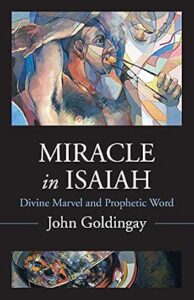
Prophet’s Prediction or Pundit’s Projection? A Response to John Goldingay
Dr. Leong Tien Fock (PhD in Semitic Languages and Literatures)*
God uses the prophecy of Isaiah—particularly the long-term prediction concerning Cyrus and his role in the return of the Jewish exiles to restore Jerusalem—to demonstrate that he alone is God and that he has spoken through his prophets. Critical scholarship has long claimed that this “prophecy” is a pundit’s projection rather than a prophet’s prediction. We would ignore this claim if it were confined to critical scholarship. However, recently John Goldingay (2022), who is considered an evangelical scholar, has written a book on “miracle” in Isaiah that promotes the critical view of prophecy in an attempt to show that such a view is consistent with a faithful reading of Scripture. And the book has been endorsed by evangelical scholars. Thus, a critical response is warranted and necessary.
Goldingay distinguishes two approaches to reading a text like Isaiah. The “etic” approach “is one that starts from my cultural framework and makes my cultural assumptions,” whereas the “emic” approach is “one that works within the cultural framework presupposed by Isaiah” (3). The “emic” approach is to read the text within the narrative world of the Bible and its plausibility structure.1The narrative world of the Bible is the world presented in the overarching narrative from Genesis to Revelation. Since this world is grounded in Genesis 1:1, it represents the world God created—the world we live in. A plausibility structure “is a social structure of ideas and practices that create the conditions determining what beliefs are plausible within the society in question” (Newbigin 1986: 10). What is “obvious” and “rational” to one in a plausibility structure may be “obscure” or “irrational” to another in a different plausibility structure. Most people, even scholars, are not aware that their thinking and feeling are constrained by a plausibility structure. The “etic” approach is to read it within the cultural world of the reader and its plausibility structure.
Which world and plausibility structure does Goldingay inhabit when he reads Scripture? He says: “I will be aiming to be the ‘implied reader,” the “ideal reader,” or the “intended reader” of the texts. In other words, I will be seeking to study my way into being the kind of person with the kind of assumptions and ways of thinking that the book itself and the author(s) of its different parts assumed when they were seeking to communicate with the audience they envisaged” (3). This gives the impression that he seeks to read the text, Isaiah in this case, within the narrative world of the Bible and its plausibility structure.
However, we need to read what Goldingay says in context. He presents his approach in terms of “my initial ‘horizon,’ which overlaps with the horizon in Isaiah but may not be identical to it. Because of the overlap, it opens up the possibility of coming to look at things from within that other horizon” (3; italics added). Thus, he first reads the text within his own horizon before reading it within the text’s own horizon. He adds that such an approach “need not presuppose that the interpreter subsequently adopts the text’s understanding or horizon or framework. An interpreter may prefer to return to the one from which they started” (4; italics added). This means the reader reads the text first within his own cultural horizon or framework (etic) and then reads the text within the text’s own cultural horizon or framework (emic).
In other words, the emic approach—to be the intended reader—follows the etic approach. It is one thing to begin and end with the emic approach to read and understand the text entirely on its own terms and then decide whether to accept the text’s understanding. It is quite another to first read the text on one’s own terms and then read it on the text’s own terms if that is even possible—it is reading the text on its own terms on one’s own terms! The subsequent “text’s understanding” is still ultimately based on the reader’s own terms.
The consequence of Goldingay’s approach on his understanding of Isaiah is clear. He affirms that Isaiah 1:1, which introduces the book of Isaiah,
indicates that what will follow in the book will be the “vision” (ḥāzôn) that Isaiah ben Amoz “beheld” (ḥāzâ); the noun and the verb are related . . . . The expression “the vision that Isaiah ben Amoz beheld” refers not to a single event . . . but to the broader content of what follows in the Isaiah scroll. . . . As well as describing what will follow as a vision, 1:1 specifies that it was the vision of this specific person, “Isaiah ben Amoz,” that it related to a specific place, “Judah and Jerusalem,” and that Isaiah saw it in a specific time, the reign of four named kings. . . . [This] last element indicates that it is the introduction not simply to Isaiah 1 but also to the collected messages of Isaiah (25–27).
This is a faithful reading of Isaiah 1:1, and it implies the traditional understanding that the entire book of Isaiah is written by Isaiah in Jerusalem in the eighth century BC. However, Goldingay qualifies:
I assume that actually, the book of Isaiah as a whole includes messages from other figures after Isaiah who lived at least a quarter of a millennium subsequently. . . . I take a conservative and traditional version of the mainstream scholarly view that much of Isaiah 1–39 does go back to Isaiah ben Amoz [in the eight century], that most if not all of Isaiah 40–55 goes back to someone who worked in Cyrus’s time in the 540s, that most if not all of Isaiah 56–66 goes back to someone or to more than one person who worked nearer the end of the sixth century, and that the book was put into the form that we have in the fifth century (4–6; italics added).
Though Goldingay does not limit the reference of Isaiah 1:1 to only Isaiah 1, he does limit it to only Isaiah 1–39. However, the book of Isaiah as we have it has only one introduction to the contents that follows, which plainly means they cover chapters 1–66. And there is no evidence whatsoever that the book of Isaiah ever existed in a form other than what we have today. Goldingay is not reading Isaiah on its own terms. Presumably this is Goldingay’s etic approach that precedes his emic approach.
What then are the cultural framework and assumption(s) behind this etic approach? According to him, “references to the rise of Cyrus the Persian (44:28; 45:1) have traditionally and understandably been taken as Isaiah ben Amoz’s predictions, which by implication were then miraculous predictions. Yet they actually present themselves as coming from Cyrus’s own time, not from the time of Isaiah ben Amoz” (12). In the endnote, Goldingay says, “See further the comments on Cyrus in the section on ‘Yahweh Determined’ in chapter 4” (243). However, in that section, there is neither evidence nor argument that the references to Cyrus are from the time of Cyrus and not Isaiah.2A text like Isaiah 41:21–29 does refer to the rise of Cyrus (v. 25; cf. 46:11) as “unfolding before the [exilic] Judahites’ eyes” (Goldingay 2022: 148). It is indeed addressing the exilic audience as though the speaker were present with them. However, this is not evidence that the text must come from the time of Cyrus. To argue otherwise assumes that Isaiah could not have written it specifically for the future exilic audience, addressing them as if he were there—a rhetorical strategy unique to him. There is evidence that references to Cyrus do come from Isaiah’s time: his rise is said to have been declared “from the beginning” (v. 26), a notion rephrased as “declaring the end from the beginning and from ancient times” (46:10). We can infer from Isaiah’s argument in chapters 41–48 why he would use this rhetorical strategy: God says he announced Cyrus “from of old” precisely because the exilic audience is “obstinate”—otherwise, they would give credit to their idols when Cyrus set them free to return to Jerusalem (48:3–5). It is simply assumed, just as it is assumed that the book of Isaiah includes messages from other figures after Isaiah.
Evidently, the cultural assumption behind the denial that Isaiah wrote the entire book is that they could be no “miraculous predictions,” a standard materialistic and thus anti-supernaturalistic presupposition of the world of historical-critical scholarship.3This is corroborated by Goldingay’s approach to the prophecies of Daniel, as summarised in a review of his commentary on the book of Daniel:
Goldingay fairly consistently follows the historical critical interpretation of the book of Daniel. All the prophecies are considered to be vaticinia ex eventu, i.e., prophecies written after the events they portray, since “it is not the nature of biblical prophecy to give a literal account of events before they take place” (p. 305). . . . [D]espite Goldingay’s claim to believe that God is capable of knowing future events and thus of revealing them, there is not a single place in the book of Daniel where he believes predictive prophecy actually occurred (Pfandl 1991: 92–93).
On his own historical-critical terms, Goldingay’s etic approach has already assumed both that Isaiah did not write chapters 40–55 and that the references to Cyrus are not genuine predictions. These etic assumptions are then treated as if they constitute the text’s “own terms,” providing the basis on which his subsequent “emic” approach seeks to understand the text. Given these premises, Goldingay concludes that “there was nothing miraculous [supernatural] about the rise of Cyrus the Persian conqueror, about the fall of Babylon, and about Cyrus’s facilitating the restoration of Jerusalem. But in Isaiah, something counts as a miracle if it is an extraordinary event that forms part of Yahweh’s [the LORD’s] big purpose, is announced ahead of time, and then happens” (145).
This unique understanding of “miracle” in Isaiah “has nothing to say regarding the question of whether Yahweh brings about a miracle by means that operate by regular cause and effect” (2022: 19). In other words, a “miracle” is “extraordinary” but not necessarily supernatural—or rather, given his etic assumptions, it is necessarily not supernatural. Consequently, the prophecy concerning Cyrus is not a supernatural prediction of future events, but a natural projection based on what has already happened (the rise of Cyrus). Yet, Goldingay expects the original exilic audience to be so gullible as to believe that this same prophecy “frustrates the signs of liars and makes fools of diviners” as well as “confirms the word of his servant and fulfills the counsel of his messengers” (Isaiah 44:25–26).4It is beyond the scope and beside the point of this response to further engage Goldingay’s definition of “miracle” other than to note his statement here that biblical accounts of miracles “are stories about real events, which—with that involvement of the Holy Spirit of which 2 Timothy speaks—have been (miraculously!) turned into narratives that hold attention and edify” (2022: 230). This statement is misleading because, according to Goldingay, these narratives are “about real events” in the sense that “they are what movies often call ‘based on fact’” (230). Typically, movies that are “based on real events” dramatize (embellish) the facts to make the story captivating. This means we do not expect that the attention-holding and edifying aspects of the biblical narratives—the supernatural elements—correspond to the real events; rather, they are embellishments of real events to make the narratives attention-holding and edifying. Of particular significance is his claim that the embellishments are “miraculously!” inspired by God the Spirit.
Commenting on Brandon Breed’s statement that “confessional, theologically motivated readings often suspiciously end up saying exactly what the interpreter wanted them to say all along” (2022: 224–25), Goldingay rightly affirms: “Yet all readings are somewhat confessional and theologically motivated, ‘liberal’ [critical] ones as well as ‘conservative’ [evangelical] ones” (2022: 4). Breed’s statement echoes that of John Barton: “One cannot establish what the Bible means if one insists on reading it as necessarily conforming to what one already believes to be true—which is what a theological reading amounts to” (2007: 164).
Barton claims that “Biblical criticism is certainly, to use the current terms, a nonconfessional approach to the meaning of the biblical texts. The proponents of a [religiously] ‘committed’ reading are right to see it as an enemy of their position, because it requires one to put one’s own beliefs on hold while examining the meaning of the Bible” (173; italics original). Now biblical (historical) criticism presupposes materialism—the view that the spiritual does not exist.5On the “Anti-supernaturalism” of historical criticism, its grounding in “the scientific world view [read: materialism],” see David Law (2012: 22–23) Insofar as empirical science, by its very nature, can neither prove nor disprove the existence of the spiritual, materialism is itself a non-empirical belief. If historical criticism truly “requires one to put one’s own beliefs on hold,” then critical scholars should also put on hold their materialistic assumptions, which means not ruling out the supernatural when reading the Bible. Consequently, Goldingay should not compromise his emic approach by subordinating it to a prior etic framework that carries an anti-supernaturalistic presupposition.
Barton is generally correct when he complains: “To me it seems that proponents of confessing readings of the Bible risk requiring the interpreter to live inside a religious community that has closed boundaries and in which it is taken for granted that the believer has privileged access to the meaning of biblical texts” (175). However, he is wrong that proponents of “confessing” readings are limited to the “religious” community. In any case, the interpreter should read the Bible within its narrative world and plausibility structure—regardless of whether one lives inside a religious community or not. For this is the only way to allow the Bible to speak for itself on its own terms. Goldingay’s etic-then-emic approach serves as an object lesson in why even evangelical interpreters must adopt this way of reading the Bible. One need not agree with what the Bible has to say, but if one is not genuinely interested in what it says on its own terms, why read it at all?
References
Barton, John, 2007, The Nature of Biblical Criticism, Louisville, KY: Westminster John Knox Press.
Pfandl, Gerhard, 1991, Review of John Goldingay, 1989, Daniel, Word Biblical Commentary, Dallas: Word Books, Andrew University Seminary Studies 29.1: 91–93.
Goldingay, John, 2022, Miracle in Isaiah: Divine Marvel and Prophetic Word, Minneapolis: Fortress Press.
Law, David R., 2012, The Historical-Critical Method: A Guide for the Perplexed, London: T & T Clark.
Newbigin, Lesslie, 1986, Foolishness to the Greeks: The Gospel and Western Culture, Grand Rapids: Eerdmans.
* Dr. Leong Tien Fock has a degree in Civil Engineering from the University of Malaya and an M.A. in Old Testament Studies from Wheaton College Graduate School. He also has an M.A. and a Ph.D. in (ancient) Near Eastern Languages and Cultures from the University of California, Los Angeles. His Ph.D thesis, entitled Tense, Mood and Aspect in Old Babylonian, is a computer-assisted linguistic analysis of the language of Hammurabi. His recent publications include Our Reason for Being: An Exposition of Ecclesiastes on the Meaning of Life (Wipf & Stock Publishers, 2022).
Related post written by Dr. Leong Tien Fock
In Defence of Prophetic Authorship and Unity of the Book of Isaiah Part 1/2
The publisher’s choice of the book cover which is a painting by Edward Knippers, “Isaiah in the Temple, 2008” is not accidental. It includes some “Picasso”-like cubism images which appropriately reflect the Goldingay’s critical scholarship which argues that the Book of Isaiah comprises a compilation of fragments from multiple authors. Goldingay rejects the traditional-conservative view of the unity of the Book of Isaiah which originated from the prophet Isaiah in the 8th century BC?
Quote from internet.
Edward Knippers is a visual artist whose large-scale body of work spans 50 years of practice and explores various genres, including figurative, expressionism, abstraction, and cubism.
Image Journal said of Edward Knippers that he is “without a doubt, one of the founding fathers of contemporary efforts to explore the relationship between Christian faith and the creation of outstanding new visual art.”
Alongside garnering numerous awards and accolades, Ed’s work has been the subject of much controversy. It has been banned, defaced, and even mutilated. The nudity, sometimes violent or disfigured forms within his paintings, have left some viewers offended at his imaginative handling of the biblical narratives.
Excellent assessment. Thanks Kam Weng.