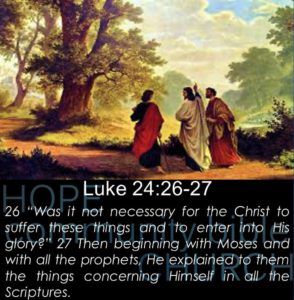
Resurrection of Christ as Fulfilment of God’s Covenant Promise of Salvation. BADR Part 5

Resurrection of Christ as Fulfilment of OT Prophecy of Salvation. BADR 5

Kairos Podcast Series 8: Biblical Anthropology, Death and Resurrection (BADR Part 5)

Question: How is the hope of Israel that believers will be resurrected and enjoy the eternal presence of God related to the resurrection of Christ?

God’s covenant was the promise and fulfillment of Israel’s hope of resurrection:
1) God’s promise of covenantal inheritance in his covenant with Abraham and his descendants. “And I will establish my covenant between me and you and your offspring after you throughout their generations for an everlasting covenant, to be God to you and to your offspring after you” (Gen. 17:7).

2) The qualifier “everlasting covenant to be God to you and to your offspring” points to the eternal salvation of the person who believed in God. “God is everlasting, the promised inheritance under the covenant consists of reconciliation to this eternal God, and it is therefore only to be expected that God’s elect should continue to exist in fellowship with Him.” (Barton Payne)

3) The resurrection of Christ is fulfilment of God’s covenant promise of salvation. The everlasting covenant promise and eschatological hope of Israel is the necessary framework to understand Christ’s resurrection. Conversely, Christ’s resurrection proleptically realized the eschatological promise of the covenant.

Acts 2: 23-24 The keynote in Peter’s first sermon on the day of Pentecost: “this Jesus, delivered up according to the definite plan and foreknowledge of God, you crucified and killed by the hands of lawless men. God raised him up, loosing the pangs of death, because it was not possible for him to be held by it.” // Psa. 16:8-11

Acts 2: 27 – “For you will not abandon my soul to Hades, or let your Holy One see corruption. Peter saw this fulfilled literally in Jesus’ resurrection from the grave after only three days. He died as the Scriptures revealed He would (according to the Scriptures)”.

You can view the video at –
Resurrection of Christ as Fulfilment of OT Prophecy of Salvation. BADR 5
Biblical Dualism and the Soul Between Death and Resurrection (the Intermediate State)

Death, Resurrection and Life Everlasting DRLE Pt.2
Death involves disintegration of a person’s vital power, cessation of bodily life, and separation of the body and the soul (nepeš): Gen. 35:18; 1 Kings 19:4).  Does the soul continue to exist after the death of the person? The monist theologian’s answer is “no”. Monism argues that according to the Bible, a human being is not divided into separate parts, i.e. body, soul, and spirit, but he exists as a unified or holistic self. Since the soul and the body are just different aspects of a person, existence entails bodily existence. There is no possibility of disembodied existence of the soul after death. The purpose of this post is to show that monism contradicts the Bible which ascribes to the disembodied soul some forms of consciousness in the intermediate state between death and final resurrection.1This post focuses on the biblical teaching on the soul’s disembodied existence in the intermediate state. For a philosophical defence of the tenability of disembodied existence of the soul, see Paul Helm, “A Theory of Disembodied Survival and Re-embodied Existence,” Religious Studies (1978), pp. 15-26; Richard Purtill, “Disembodied Survival,” Sophia 12 (1973), pp. 1-10. Continue reading “Biblical Dualism and the Soul Between Death and Resurrection (the Intermediate State)”

  • 1
    This post focuses on the biblical teaching on the soul’s disembodied existence in the intermediate state. For a philosophical defence of the tenability of disembodied existence of the soul, see Paul Helm, “A Theory of Disembodied Survival and Re-embodied Existence,” Religious Studies (1978), pp. 15-26; Richard Purtill, “Disembodied Survival,” Sophia 12 (1973), pp. 1-10. ↩︎

OT Anthropology. The Constituent Elements of Man. DRLE Pt.1

Death, Resurrection and Life Everlasting – DRLE Pt.1

A. Contemporary Criticism Against Biblical Dualistic Anthropology
Our understanding of death and afterlife depends on what Scripture says about the nature of man. However, the OT presents no systematic discussion of the nature of man, any more than it does of the nature of the triune God. Nevertheless, the Bible often refers to human nature as dualistic, that is, human nature is a combination of two distinct and separable entities, the material body and the immaterial soul which survives death.

However, the contemporary intellectual climate is inimical toward the traditional Christian teaching of dualism. The various objections raised against dualism include the following: 1) The theory of evolutionary psychology and scientific naturalism undermines belief in the human soul. 2) New research in neuroscience and behavioristic psychology claims to have identified direct causal relation (although this at best could be correlation) between brain functions and states of consciousness. This has rendered irrelevant the idea of the faculties of the soul & a fortriori the idea of the soul. Continue reading “OT Anthropology. The Constituent Elements of Man. DRLE Pt.1”