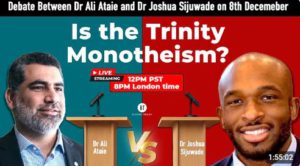
 Debate: Is the Trinity Monotheism?
Joshua Sijuwade’s philosophical model of the Trinity is sophisticated and impressive. His analytical model of the Trinity is logically coherent, but as any logician or mathematician knows, one can always construct a consistent philosophical (or mathematical) system based on a chosen set of definitions, assumptions or axioms (so long as it does not claim completeness). More importantly, theoretical models, however sophisticated or coherent, must be grounded in historical reality and divine revelation. In this regard, viewers of the debate need to be convinced that Sijuwade’s splendid system of philosophical trinitarianism is consistent with biblical revelation and the Trinitarian doctrine which was framed in the Nicene Creed (AD 325, 381).
Ali Ataie suggests that the chart or Trinitarian scheme presented by Sijuwade is a form of Sabellianism. He also refers to Origen to suggest that Sijuwade’s monarchical model is not exactly (classical) Trinitarian since his model implies that only the Father has aseity, but not the Son or the Holy Spirit. Even then the Father’s aseity is not intrinsic (which is evidence that Ali does not fully understand the meaning of such a fundamental concept as aseity). Ali even argues that the Father cannot be fundamental since his identity as Father is dependent on another person outside of himself. Continue reading “Is the Trinity Monotheism? Dr. Ali Ataie vs. Dr. Joshua Sijuwade. A Debate hosted by Blogging Theology”


 Some young Calvinists I know are not sure how to respond to their friends who reject the Calvinist doctrine of God’s foreknowledge and predestination with a self-assured declaration, “No thanks, Calvinist predestination is theologically and logically problematic. I prefer Luis de Molina’s teaching of the “scientia media or middle knowledge as it is more coherent and persuasive.” These young Calvinists become unsettled and feel intimidated by the unfamiliar terminology thrown at them. However, a simple question would dispel the Molinist’s aura of sophistication. “As a Molinist, are you then a Jesuit or an Arminian? Since you are Protestant, I conclude that you are basically rebranding old-time Arminianism by using exotic language, granted that the idea of a divine middle knowledge is at the heart and soul of the Arminian view.”