John Owen’s Double Payment Argument for Definite Atonement and the Arminian Universalist Dilemma


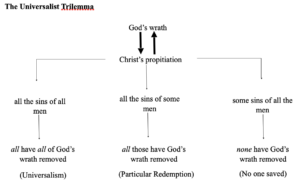
Universalism = Christ Died for the sins of all people without exception

I. John Owen, in The Death of Death in the Death of Christ (1648), offers a classic defence of definite atonement—the doctrine that Christ’s death was both definite in purpose and effective in accomplishment. Christ died not for humanity in general, but specifically for the elect whom the Father had given him; and his death actually secured their redemption.

Owen advances two powerful arguments in defence of this position.

The Double Payment Argument

Sin is a debt owed to God’s justice. Christ’s death has fully paid the penalty for sin. If Christ died for all people universally, then all must be saved, because a just creditor does not demand payment for the same debt twice. Exacting double punishment—first on Christ, then on the condemned sinner—is unjust. Yet Scripture clearly teaches that not everyone is saved. Therefore, Christ did not die for all people universally, and his atoning work was intended only for the elect – This is an argument to the contrary. (John Owen, The Works of John Owen, Goold ed. [Banner of Truth reprint, 1989], vol. 10, p. 173. All subsequent citations refer to this edition.)

The Universalist Dilemma
Owen then challenges the universalist claim that Christ died for every individual human being. He argues that this position entails one of three possibilities: Christ bore (1) all the sins of all people, (2) some of the sins of all people, or (3) all the sins of some people. Option (1) entails universal salvation, which contradicts Scripture. Option (2) means every person still stands condemned for their remaining sins. Only option (3) is logically coherent and scripturally grounded. Owen concludes that Christ died for all the sins of the elect alone. Continue reading “John Owen’s Double Payment Argument for Definite Atonement and the Arminian Universalist Dilemma”

Introducing John Calvin On God’s Providence

John Calvin on God’s Providence. JCGP Part 1/3
Introducing John Calvin On God’s Providence

John Calvin has long been associated with the doctrine of predestination so much so his exposition of the doctrine of God’s providence is often overlooked. Yet the latter is a pervasive theme in many of his writings and in his ministry as a pastor. In this lecture/talk, you will be introduced to a brief history of his exposition of this important doctrine, its development within his magnum opus (Institutes of the Christian Religion), and his treatment of the subject in Chapters 16-18 of Book 1 of the 1559 final edition of the Institutes. As shall be evident, while he was concerned to refute his opponents’ erroneous views of God’s providence, he was even more concerned that their views arose from a defective view of God, as revealed in Scripture.

You may view the full video at
Introducing John Calvin On God’s Providence

“Regeneration Precedes Faith”. An AI-assisted Calvinist Rebuttal to Arminian David Allen’s Analysis of Key Verses in 1 John


1 John 5:1 Πᾶς ὁ πιστεύων ὅτι Ἰησοῦς ἐστιν ὁ Χριστός, ἐκ τοῦ θεοῦ γεγέννηται, καὶ πᾶς ὁ ἀγαπῶν τὸν γεννήσαντα ἀγαπᾷ [καὶ] τὸν γεγεννημένον ἐξ αὐτοῦ.

I. Does the Calvinist teaching “regeneration precedes faith” find support in Greek grammar?

Within Reformed (Calvinist) theology, it is maintained that regeneration logically precedes faith. That is, fallen human beings—being spiritually dead—are incapable of believing unless the Holy Spirit first imparts new life. This doctrine safeguards the monergistic character of salvation: it is wholly the work of God’s grace and not dependent on human initiative.

Several biblical texts are commonly cited in support of this position:
1. John 3:3–8 “Unless one is born again he cannot see the kingdom of God.” Jesus teaches that spiritual rebirth is a necessary precondition for perceiving and entering the kingdom. Faith—understood as seeing and believing—follows regeneration.
2. 1 John 5:1 “Everyone who believes [present active participle] that Jesus is the Christ has been born [perfect passive verb] of God.”  The Greek construction suggests that the state of having been born of God grounds the act of believing.
3. Ephesians 2:4–5 “Even when we were dead in trespasses, [God] made us alive together with Christ.” A dead person must be made alive (regenerated) before he can exercise faith.

II. Allen’s Challenge
In his article “Does Regeneration Precede Faith?” (JBTM, 2014), David Allen challenges the Reformed interpretation of 1 John 5:1, arguing that the claim “regeneration precedes faith” cannot be proven from Greek grammar. According to Allen, “The most that can be said from the Greek present participle and perfect tense verb combination is that the actions are contemporaneous” (p. 41). He appeals to the broader context of John’s writings, noting that passages such as John 20:31 present faith as the condition for life, not its result. Continue reading ““Regeneration Precedes Faith”. An AI-assisted Calvinist Rebuttal to Arminian David Allen’s Analysis of Key Verses in 1 John”

Sharing Christ’s Suffering and Resurrection. C.H. Spurgeon & O. Chambers


“I am crucified with Christ” Galatians 2:20.

The Lord Jesus Christ acted in what he did as a great public representative person, and his dying upon the cross was the virtual dying of all his people. Then all his saints rendered unto justice what was due and made an expiation to divine vengeance for all their sins. The apostle of the Gentiles delighted to think that as one of Christ’s chosen people, he died upon the cross in Christ. He did more than believe this doctrinally, he accepted it confidently, resting his hope upon it. He believed that by virtue of Christ’s death, he had satisfied divine justice, and found reconciliation with God. Beloved, what a blessed thing it is when the soul can, as it were, stretch itself upon the cross of Christ, and feel, “I am dead; the law has slain me, and I am therefore free from its power, because in my Surety I have borne the curse, and in the person of my Substitute the whole that the law could do, by way of condemnation, has been executed upon me, for I am crucified with Christ.”

But Paul meant even more than this. He not only believed in Christ’s death, and trusted in it, but he actually felt its power in himself in causing the crucifixion of his old corrupt nature. When he saw the pleasures of sin, he said, “I cannot enjoy these: I am dead to them.” Such is the experience of every true Christian. Having received Christ, he is to this world as one who is utterly dead. Yet, while conscious of death to the world, he can, at the same time, exclaim with the apostle, “Nevertheless I live.” He is fully alive unto God. The Christian’s life is a matchless riddle. No worldling can comprehend it; even the believer himself cannot understand it. Dead, yet alive! Crucified with Christ, and yet at the same time risen with Christ in newness of life! Union with the suffering, bleeding Saviour, and death to the world and sin, are soul-cheering things. O for more enjoyment of them! Continue reading “Sharing Christ’s Suffering and Resurrection. C.H. Spurgeon & O. Chambers”