Secularism as Unintended Consequence of Luther’s Nominalism and Reformation (Brad Gregory)? Part 1
Many historians have identified philosophical nominalism, which became influential in the European universities of the fourteenth century, as a major factor in the breakdown of the synthesis of Christianity and Greco-Roman thought that had served as the basis of intellectual life and religious life of medieval society for 1000 years. As this synthesis weakened, so too did the religious authority that undergirded the social and cultural order of medieval Christendom.
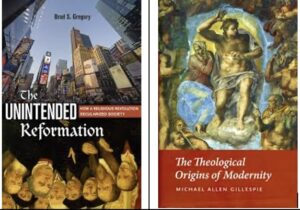
One influential school of thought in contemporary Western academia—associated with figures such as John Milbank (Radical Orthodoxy), Louis Dupré (Passage to Modernity), and Brad Gregory (The Unintended Reformation, 2012)—has advanced a more focused genealogical argument. According to this narrative, the Protestant Reformation functioned as a principal carrier of nominalism, thereby eroding the participatory metaphysics and epistemological foundations of Western culture. Michael Horton summarizes this thesis succinctly: “According to this story, the Reformation was a prime carrier of the nominalism that has emptied into the gulf of postmodern nihilism”1Michael Horton, Justification, vol. 1, p. 311. Ironically, the prominent Malaysian Muslim scholar Syed Muhammad Naquib al-Attas places the blame for secularism not on nominalism but on Thomas Aquinas, despite the fact that Thomism is fundamentally antithetical to nominalism. In Islam and Secularism, al-Attas interprets Thomistic philosophy as a source of secularization, a reading that many historians of medieval thought would regard as historically problematic. Unsurprisingly, some of his followers view the rise of secularism in the West as evidence of Christianity’s theological failure and the absence of genuine revealed truth within the Christian tradition
In The Unintended Reformation (2012), Gregory argues that the influence of late medieval nominalism on Reformers such as Martin Luther contributed to the rejection of the universal truth claims that had undergirded medieval theology, particularly the authority of a unified church. Once ecclesiastical authority fragmented, competing interpretations of Scripture proliferated. Over time, Gregory argues, this doctrinal pluralization weakened confidence in religious truth itself and paved the way for relativism and secularism.2For the purpose of this article, “secularism” refers to the removal of religious institutions and their influence from the public sphere. A more comprehensive definition, articulated by Jean Bauberot, includes: 1) separation of religious institutions from the institutions of the state and no domination of the political sphere by religious institutions; 2) freedom of thought, conscience, and religion for all, with everyone free to change their beliefs and manifest their beliefs within the limits of public order and the rights of others; 3) no state discrimination against anyone on grounds of their religion or non-religious world view, with everyone receiving equal treatment on these grounds. (cf: Andrew Copson, Secularism: A Very Short Introduction (OUP, 2019), p. 2).
To be sure, Gregory’s use of the term “unintended” may be meant to exculpate Luther from direct responsibility for these developments. Yet the rhetorical effect of the argument remains clear: even if the consequences were unintended, the Reformation still appears as the decisive catalyst for the collapse of the medieval religious worldview.
Despite its sophistication and erudition, Gregory’s genealogical thesis is open to serious criticism. The historian Carl Trueman has highlighted a fundamental methodological weakness in the concept of “unintended consequences.” The category is so elastic that it can be used to assign causal responsibility in historically dubious ways. Trueman remarks wryly that, “given the way in which Jews were transported to Auschwitz, one could make the case that the Holocaust was an unintended consequence of the invention of the steam locomotive.” The point is not to trivialize historical causation, but to warn against overly simplistic genealogies that flatten the complexity of intellectual and social developments.
At the heart of the Milbank-Gregory thesis lies the assumption that Luther was fundamentally a carrier of nominalism. According to this view, nominalism undermined the Aristotelian-Thomistic synthesis that had provided medieval Europe with an integrated framework for understanding cosmic order, morality, politics, and human life. Once this synthesis disintegrated, the fragmentation of intellectual and social institutions supposedly paved the way for secular modernity.3Some defining features of modernity are said to include: (a) epistemology — the autonomous self as the final authority in judgment; (b) ethics — the sovereign self that recognizes only self-generated moral norms; (c) social structure — the differentiation and specialization of institutions previously integrated under religious authority; (d) economics — the rationalization of production and exchange on the basis of calculability and efficiency; and (e) governance — bureaucratic administration operating as what Max Weber called an “iron cage.” These features are interrelated and mutually reinforcing.
This assumption is open to several challenges. Before taking up those challenges, however, it is necessary to examine what nominalism, especially as associated with the fourteenth-century thinker William of Ockham, actually taught, so that the question of Luther’s relationship to it can be assessed on firm ground. Given below is a close summary of Michael Allen Gillespie’s extensive comments on nominalism in his book, The Theological Origins of Modernity:
1. Rejection of Universals
Classical realist philosophy argued that individual things display shared natures, termed universals. On this view, universals such as “humanity,” “triangularity,” and “justice” are ultimately real, and individual beings are particular instances of these universals. Nominalism rejects this entirely. For the nominalist, reality consists only of individual, discrete things — each existing in and of itself. There are no universal properties or shared essences; there are only particular human beings and particular triangle-shaped things. Universal concepts such as “humanity,” “goodness,” and “justice” are merely names (nomina) or mental constructs used to categorize individual things that resemble one another.
2. Epistemological Skepticism
Because universals are reduced to mental constructs, nominalism weakens confidence in humanity’s ability to know reality through universal concepts. Thomistic realism had argued that universal concepts are abstracted from real features embedded within creation. Although universals exist in the mind, they correspond to objective structures in reality.
Nominalism severs this correspondence. If universal or general concepts have no basis in reality beyond the mind that forms them, then words and concepts tell us nothing certain about the world. This creates the conditions for skepticism regarding the reliability of human knowledge of reality.
3. Divine Voluntarism
Nominalism also emphasized divine voluntarism—the priority of God’s will over God’s rational nature. God’s actions are not determined by any intrinsic rational order. Medieval theology distinguished between God’s potentia ordinata (ordained power) and potentia absoluta (absolute power). While God has freely ordered the present world in a stable manner, nominalism stressed that God could have ordered things otherwise. God’s will is therefore supreme and is not constrained by human logic or by any standard of inherent goodness or rationality. He wills things simply because he chooses to will them. This priority of divine will over divine intellect — voluntarism — is also mirrored in the nominalist understanding of human nature, where the will similarly has priority over the intellect.
4. Radical Disjunction Between God and Creation
Nominalism weakened the metaphysical continuity between God and creation. Medieval participatory metaphysics had viewed creation as reflecting divine rationality and order. By contrast, nominalism emphasized the sheer contingency of creation. God could create directly without mediation through hierarchical causal structures or intrinsic forms. Gillespie summarizes the implications:
Faith alone, Ockham argues, teaches us that God is omnipotent and that he can do everything that is possible…Creation is thus an act of sheer grace and is comprehensible only through revelation… There is thus no immutable order of nature or reason that man can understand and no knowledge of God except through revelation. (Gillespie, p. 23)
As a result, the classical synthesis of reason and revelation was destabilized. Nature no longer appeared intrinsically intelligible. Knowledge increasingly depended upon empirical investigation rather than metaphysical deduction from universal principles. Gillespie further observes that because each being exists contingently by divine will, there can be no a priori knowledge of nature. Human beings must investigate phenomena experimentally rather than deducing truths syllogistically from fixed essences. In this respect, nominalism contributed indirectly to the rise of empirical science. Yet the same move also results in profound metaphysical uncertainty and anxiety.
5. Moral Instability
If universals have no objective reality, then universal moral norms become difficult to ground metaphysically. Moral order risks becoming contingent, voluntaristic, or situational. The danger is not necessarily immediate moral nihilism, but the erosion of confidence in an objective moral order rooted in the nature of reality itself.
6. Loss of Religious Certitude
Gillespie argues that the God disclosed by nominalism increasingly appeared arbitrary and unpredictable rather than rationally trustworthy. The distance between God and humanity widened dramatically. If God’s will is utterly unconstrained, then neither natural law nor moral reasoning can provide reliable assurance regarding salvation or divine favor.
In this context, medieval believers could easily experience profound existential insecurity. The cosmos no longer appeared as a rationally ordered hierarchy reflecting divine wisdom, but as a contingent order suspended entirely upon inscrutable divine will.
The God that nominalism revealed was no longer the beneficent and reasonably predictable God of scholasticism. The gap between man and God had been greatly increased. God could no longer be understood or influenced by human beings — he acted simply out of freedom and was indifferent to the consequences of his acts. He laid down rules for human conduct, but he might change them at any moment. Some were saved and some were damned, but there was only an accidental relation between salvation and saintliness, and damnation and sin. It is not even clear that this God loves man. The world this God created was thus a radical chaos of utterly diverse things in which humans could find no point of certainty or security. (Gillespie, pp. 24–25)
7. The Shift from God to Human Subjectivity
According to Gillespie, modern notions of subjectivity emerged partly from this nominalist background. Once confidence in a rationally ordered cosmos weakened, human beings increasingly turned inward toward the knowing and willing subject as the new foundation of certainty.
Gillespie therefore argues that the modern autonomous self, exemplified in thinkers such as René Descartes, reflects a transformed inheritance from nominalism. The emphasis shifts from participation in a divinely ordered cosmos to the self-assertion of human reason and will.
The Crisis Produced by Nominalism
Nominalism sought to strip away what it regarded as the rationalistic domestication of God within scholastic metaphysics. Yet in doing so, it often produced a vision of God as radically unknowable, unpredictable, and disconnected from stable rational order.
The consequences were far-reaching:
1. God remained sovereign, but divine action increasingly appeared arbitrary or capricious.
2. The medieval worldview, which viewed creation as reflecting divine rationality, was undermined.
3. Intellectual fragmentation contributed to skepticism regarding religious truth and moral objectivity.
4. Human subjectivity gradually displaced God as the primary locus of meaning and knowledge. (Gillespie, p. 29)
In this sense, nominalism did contribute significantly to some of the intellectual conditions that later characterized secular modernity—especially epistemological skepticism and moral relativism. Nevertheless, an important question remains: did Luther and the Protestant Reformation simply inherit and transmit nominalism into the modern world?
This claim is far from self-evident. It is historically simplistic to portray the Reformation as merely the triumph of Ockhamism. Although Luther was educated within a late medieval context influenced by nominalism, the theological heart of the Reformation drew far more deeply from Augustine of Hippo than from Ockham. Indeed, Luther’s fiercest theological opponents in the early sixteenth century were often representatives of late medieval scholasticism such as Gabriel Biel.
We shall argue that the Reformation represented not the triumph of nominalism, but in crucial respects a protest against the theological and spiritual crisis generated by late medieval nominalism. Far from dissolving Christianity into secular modernity, the Reformers sought to recover a more biblical and Augustinian understanding of God, grace, and salvation.
In my next post, I will demonstrate that Luther’s thought was actively opposed to nominalism and voluntarism, arguing instead that the Reformer drew his resources primarily from Augustine rather than the medieval nominalist tradition. Far from carrying nominalism forward, Luther’s rediscovery of the gospel of grace constituted a decisive break from the nominalist framework—exemplified by Gabriel Biel—that had dominated late medieval piety and theology.
References
Carl Trueman, “Did Luther Really Cause Secularism?” Themelios, Nov. 10, 2017
Michael Allen Gillespie, The Theological Origins of Modernity (Uni. Chicago Press, 2008).
Michael Horton, Justification 2 vols. (Zondervan, 2018).
Related Posts
Secularism as Unintended Consequence of Luther’s Nominalism and Reformation (Brad Gregory)? Part 2
Nominalism, Humanism, and the Rise of Secularism: A Corrective to Syed Muhammad Naquib al-Attas