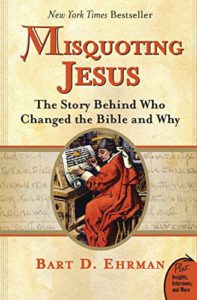
 Bart Ehrman’s primary mission in life is undeniable. It is to discredit Christianity and to deconvert Christians from their faith. Ehrman’s attack on Christianity has been effective because he claims to be speaking as an objective historian (which is debatable), in contrast to apologists and theologians defending their faith and because he is speaking as a lapse fundamentalist with insider-knowledge. Ehrman’s attack on Christianity is comprehensive, but I shall only highlight three of his favorite lines of attack on Christianity. Continue reading “Bart Ehrman’s Historical Revisionism. Part 1/3. Misquoting Scripture”
Author: Kam Weng Ng
Part 6: Historical Precursors of Argument from Fine-Tuning and Intelligent Design
 Series: Fine-tuning of the Universe and Intelligent Design
Question: The discovery of fine-tuning of the universe which makes life possible has led many scientists to think that this cannot be mere coincidence. Explain what is meant by fine-tuning of the universe and why this discovery is important for Christianity.
Discussants: Dr. Ng Kam Weng and Dr. Rodney Toh.
You are welcome to join the discussion at:
Part 6: Historical Precursors of Argument from Fine-Tuning and Intelligent Design
Please forward this message if you find the video discussion helpful.
Faith and Integration of Knowledge. Part 5. Young Earth Creation vs Old Earth Creation
Part 5: Young Earth Creation vs Old Earth Creation
Question: Does the evidence from the bible and science support young earth creation or old earth creation?
Discussants: Dr. Ng Kam Weng and Dr. Rodney Toh.
You are welcome to join the discussion at:
Part 5: Young Earth Creation vs Old Earth Creation
Please forward this message if you find the video discussion helpful.
Faith and Integration of Knowledge. Part 4. Christian Foundation of Modern Empirical Science
Faith and Integration of Knowledge
Christian Foundation of Modern Empirical Science
Part 4. Question: Christians have argued that the emergence of modern science is premised on presuppositions of the Christian worldview. What are some of these unique features in the Christian worldview that contribute to the emergence of modern empirical science?
Discussants: Dr. Ng Kam Weng and Dr. Rodney Toh.
You are welcome to join the discussion at:
Part 4. Christian Foundation of Modern Empirical Science
Please forward this message if you find the video discussion helpful.
Faith and Integration of Knowledge. Part 3. How Do We Integrate Science and Christianity?
Faith and Integration of Knowledge
Part 3. Question: How do we integrate science and Christianity?
Discussants: Dr. Ng Kam Weng and Dr. Rodney Toh.
There are six ways to relate science and Christianity: conflict, independence, complementation, dialogue, integration and transformation.
You are welcome to join the discussion at:
Part 3. Question: How do we integrate science and Christianity?
Please forward this message if you find the video discussion helpful.
Faith and Integration of Knowledge. Part 2. What is the Relationship Between the Bible and science?

Question: If there is no conflict between Christianity and science, does this mean that the Bible is scientifically reliable? What is the relationship between the Bible and science?
Discussants: Dr. Ng Kam Weng and Dr. Rodney Toh.
You are welcome to join the discussion at:
What is the Relationship Between the Bible and science?
Please forward this message if you find the video discussion helpful.
Faith and Integration of Knowledge. Part 1 – Alleged Conflict between Science & Christianity

Part 1. Alleged Conflict between Science & Christianity
Question: If Christianity is based on faith in the supernatural world, whereas science is based on facts in the natural world, then they are incompatible. To what extent is this correct?
Discussants: Dr. Ng Kam Weng and Dr. Rodney Toh.
You are welcome to watch the video and join the discussion at:
Alleged Conflict between Science & Christianity
A Critique of Ismail Faruqi’s Metareligion and Ethical Analysis of Christianity. Part 3/3
Faruqi sharpens his critique of the Christian doctrine of God by asserting that Christianity,
eternalizes the revelation of Christ not as a system of ideas that may be God’s will, but as the Christ-event. . . Christianity consistently argues that Christ (i.e. his significance) is not the will of God, nor his command, nor His idea, but God Himself, or rather God co-eternal with God. Christianity is driven to this deifying hypostasis because it eternalizes a real person and a real event. A person may be co-eternal with God, but not derivatively eternal without violating the law of identity. But to violate the law of identity in this instance is to lapse into polytheism (CE 228).
Unfortunately for Faruqi, his objection is only hitting at theological strawmen since Christians are not asserting that Christ is identical with God without remainder in his incarnate state. Indeed, Faruqi’s objection is self-defeating. If he accuses Christianity of eternalizing a historical person, his religious philosophy commits the same logical move by eternalizing the Quran which was revealed to its messenger in 7th century Arabia. Continue reading “A Critique of Ismail Faruqi’s Metareligion and Ethical Analysis of Christianity. Part 3/3”
A Critique of Ismail Faruqi’s Metareligion and Ethical Analysis of Christianity. Part 2/3
II. Methodological And Doctrinal Distortions
A. Jesus’ Interiorization of Law
In part 1/3, I highlighted some problems with Faruqi’s methodology as its premises give a distorted reading of Christianity and skew the evidence in favor of Islam. The distortions become evident when Faruqi seeks to rewrite the history of the mission and ministry of Jesus through the lens of his metareligion. Faruqi, like all Muslims, maintains a respectful attitude towards Jesus. At the same time he is persuaded that the “real” Jesus is not that of historic Christianity. For Faruqi, the real Jesus should be based on results of German historical critical method and Quranic sources. One cannot help but notice the irony when Faruqi (and other Muslim apologists) unreservedly appropriates the skeptical results of the historical critical method to critique the bible while at the same time eschewing any application of the same critical method in the study of the Quran.
Faruqi has taken considerable effort to familiarize himself with the works of critics like Joseph Klausner and C. H. Dodd. Unfortunately, his appropriation of historical research is selective and subordinated to an overriding and debatable presupposition that Jesus’ pristine religion was solely aimed at effecting an internal correction of the Jewish legalistic religion. This presupposition allows Faruqi to dismiss any Biblical teaching which he finds personally unpalatable to the corrupting influence of Jewish racialism. Jewish racialism was undeniably a harsh reality in Faruqi’s personal experience. After all, he had to abandon his role as governor of a Palestinian district when the Jews won their War of Independence in 1948. But one wonders if Faruqi has in this matter allowed his unfortunate experience to color his judgment when he analyzes the Bible. Continue reading “A Critique of Ismail Faruqi’s Metareligion and Ethical Analysis of Christianity. Part 2/3”
A Critique of Ismail Faruqi’s Metareligion and Ethical Analysis of Christianity. Part 1/3
I. Methodology
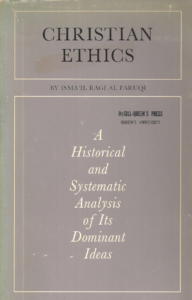
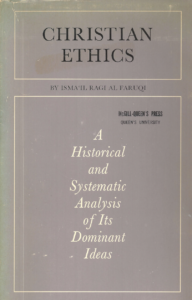
Ismail Faruqi (1921-1986) is regarded as one of the most trenchant scholarly critics of Christianity in recent times. This estimation is attested by his post-doctoral project on Christian Ethics: A Historical and Systematic Analysis of Its Dominant Ideas (1967). Its 333 pages indicate detailed familiarity with Christian thinkers ranging from Augustine to Barth and Reinhold Neibuhr. His later books on Divine Transcendence and Its Expression (1983), Al Tawhid: Its Implications for Thought and Life (1982), Islam and Other Faiths (1998) and Selected Essays (2018) demonstrate that he is well-versed in matters of Western philosophy and they are replete with sharp criticisms of Christianity. Undoubtedly, his sustained engagement with Christianity is a product of his life experiences, as a Palestinian Arab in Lebanon and subsequently as an American scholar in Harvard University and McGill University. Perhaps he also felt compelled to respond to the vigorous intellectual enterprise among Christian missionary scholars in his time. We shall analyze critically Faruqi’s work as it provides a rare opportunity for Christians to respond to Islamic misunderstanding of Christianity at the level of sophisticated scholarship. Continue reading “A Critique of Ismail Faruqi’s Metareligion and Ethical Analysis of Christianity. Part 1/3”