Definite (Limited) Atonement and Particular Redemption through Christ’s Death in Pauline Theology. Part 2/2

Definite Atonement and Particular Redemption through Christ’s Death in Pauline Theology

A) Paul consistently teaches definite atonement in several passages:
1. Acts 20:28 — The Purchased Church
Paul exhorts the Ephesian elders to shepherd the church “which he [God] purchased with his own blood.” He paid an incalculable price to save a people for himself through Christ’s death on the cross. The verb περιεποιήσατο (“purchased, obtained, gain for oneself”) denotes actual acquisition, not potential provision. This is an effective redemption, not a hypothetical one. Christ did not shed His blood in vain or indefinitely, but to redeem the Church effectually.

The object of this purchase is specific: the church (ἐκκλησία) — elsewhere called the flock, the sheep, and the bride of Christ (John 10:11; Ephesians 5:25). These are not open, universal categories; they are bounded images for a particular people. The atonement, therefore, is definite in both design and effect.

2. 1 Corinthians 11:25 Covenant Blood for a Defined People
“This cup is the new covenant in my blood” — The cup is a formal pledge that guarantees the salvation of those named within that covenant. The words echo Jeremiah 31:31–34: “And I will be their God, and they shall be my people.” The new covenant is presented as an unconditional covenant, ratified solely on the promise of the sovereign God. It gathers God’s exiled people from every nation, yet it gathers a defined people, not all people indiscriminately. Continue reading “Definite (Limited) Atonement and Particular Redemption through Christ’s Death in Pauline Theology. Part 2/2”

Definite (Limited) Atonement and Particular Redemption through Christ’s Death in Pauline Theology. Part 1/2


[responsivevoice_button voice=”UK English Female” buttontext=”Listen to Post”]

Introduction
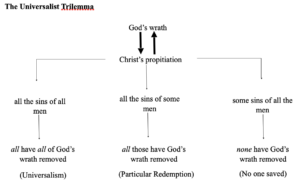
This essay argues that Paul teaches definite atonement and particular redemption—the view that Christ’s saving death and atoning work are directed intentionally toward a specific group of people, namely the elect. Christ’s atonement does not merely open the possibility of redemption; it effectually accomplishes actual redemption. This stands in contrast to the Arminian position, which holds that Christ’s death provides only a potential redemption available to all who choose to receive it.

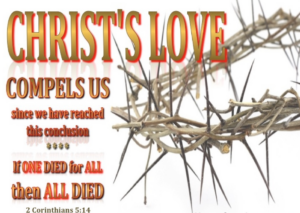
Rather than cataloguing a broad array of biblical texts, this essay anchors its analysis in one key passage—2 Corinthians 5:14-15—to highlight how the inner logic of the passage established by careful theological exegesis confirms Paul’s teaching of particular redemption. Continue reading “Definite (Limited) Atonement and Particular Redemption through Christ’s Death in Pauline Theology. Part 1/2”

Penal-Substitution as Heart of Christ’s Atonement and its Accomplishments

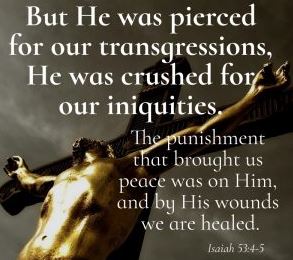
Why do Christians call the day of the crucifixion of Jesus “Good Friday”? How can an execution that results from a miscarriage of justice be good? The Christian proclamation throughout history is that it is Good Friday because on the cross of calvary, Christ took the sinner’s place (Greek: ἀντί anti, ὑπέρ huper) /1/ in bearing the guilt of man’s sin and suffering the divine punishment as our substitute in order to satisfy divine justice and bring reconciliation between God and man. “All we like sheep have gone astray; we have turned – every one – to his own way; and the Lord has laid on him the iniquity of us all…Yet it was the will of the Lord to crush him; he has put him to grief; when his soul makes an offering for guilt, he shall see his offspring; he shall prolong his days; the will of the Lord shall prosper in his hand” (Isa. 53: 6, 10). Penal-substitution is the heart of the atonement, Christ’s work of salvation.

In recent times, some theologians have highlighted alternative theories to the penal substitutionary death of Christ. I shall only focus on two of the more influential alternative theories today – the moral influence theory and the Christus Victor theory. The problem with these theories of atonement is not that they are entirely wrong. They rightly explain some aspects of Christ’s death. However, they are in reality attempts to avoid the stumbling block of penal-substitution which causes offence to modern sensibilities. These theories are deficient since they emphasize on secondary features or by-products of the atoning death of Christ in order to evade penal-substitution which is the heart of atonement. Continue reading “Penal-Substitution as Heart of Christ’s Atonement and its Accomplishments”

Series 3: The Prophecies of the Messiah and His Kingdom in the Book of Isaiah. Part 2. Is Isaiah 53 about Christ and his atoning death?

Question: The prophecies about the Suffering Servant in Isa. 53 are very confusing as the Servant appears different in the various (four) Servant songs. Is Isaiah 53 really about Christ, let alone his atoning death? And furthermore, the standard Hebrew term for “atonement” is not found in the text, how can it be about an atoning death?
Discussants: Dr. Leong Tien Fock and Dr. Ng Kam Weng.

You are welcome to join the discussion at:

Part 2. Is Isaiah 53 about Christ and his atoning death?

Please forward this message if you find the video discussion helpful.

Related Posts
The Atonement in Isaiah 53

Christ’s Death as Expiation-Propitiation (Hilasterion): Appeasing the Wrath of God

Calvin and Calvinists on the Extent of Christ’s Atonement

Calvin, not being a universalist, could be said to be committed to definite atonement, even though he does not commit himself to definite atonement. And, it could be added, there is a sound reason for this.
——————

R. T. Kendall argues in his provocative book, Calvin and English Calvinism to 1649 (Oxford UP, 1979), that the doctrine of salvation taught by the Puritans is cold, legalistic and introspective, in contrast to John Calvin’s warm and spiritually vibrant doctrine of salvation. In this regard, the Puritans who promoted a distorted form of Calvinism were influenced by Theodore Beza who succeeded Calvin in Geneva.

Kendall highlights two problems with Beza and his Puritan followers: First, Beza and his followers taught a novel doctrine of limited atonement, that is, the idea that Christ did not die for everyone in the world, but only for the elect. Kendall claims that this is a radical departure from Calvin who taught that Christ died for all but that he intercedes only for the elect. Second, Beza and the Puritans reduced the act of faith to an act of the will which contradicts Calvin’s view of faith as a persuasion of the mind. Kendall argues that the doctrine of limited atonement inevitably results in legalism and loss of assurance of salvation. Kendall presses his claim by arguing that assurance of salvation is possible only if it is grounded in Christ’s universal atonement. Continue reading “Calvin and Calvinists on the Extent of Christ’s Atonement”

Buddhist (D.T. Suzuki) Critique of the Cross

Bonhoeffer’s emphasis on the cross as evidence of the love of God which engages with the suffering of the world head-on provides a decisive answer to the Buddhist allegation that Christianity is a world-negating religion. Daisetz Teitaro Suzuki claims that the cruelty surrounding the crucifixion of Christ negates the simple realities of this life and does not compare well with the Buddhist sense of peaceful transition from this life to the next.

Christian symbolism has much to do with the suffering of man. The crucifixion is the climax of all suffering. Buddhists also speak much about suffering and its climax of all suffering is the Buddha serenely sitting under the Bodhi tree by the river Niranjana. Christ carries his suffering to the end of his earthly life whereas Buddha puts an end to it while living and goes on preaching the gospel of enlightenment until he quietly passes away under the twin Sala tree… when Buddha attained his supreme enlightenment, he was in his sitting posture; he was neither attached to nor detached from the earth; he was one with it, he grew out of it, and yet he was not crushed by it./1/ Continue reading “Buddhist (D.T. Suzuki) Critique of the Cross”

Islamic Rejection of the Crucified Messiah

The crucifixion of Jesus Christ recorded in the four Gospels is supported by impeccable testimonies of multiple eyewitnesses. The historical factuality of the cross is further attested by reports found in authoritative non-Christian historical sources like Josephus and Tacitus. The Christian witness to the crucifixion is plausible since it is inconceivable why Christians should invent the crucifixion which declares that their founder died an accursed death under divine judgment on the Cross. As such, an outright denial of the crucifixion would amount to a willful blindness to historical reality. Some Muslim critics therefore grudgingly acknowledge that historically a crucifixion did occur. However, they suggest that someone other than Jesus was crucified. They argue that Christians have misunderstood the significance of the Cross because they are victims of an illusion. God, they claim, replaced Jesus with someone that bore his likeness.

Muslim scholars bypass the historical record with an appeal to the Quranic revelation: Continue reading “Islamic Rejection of the Crucified Messiah”

Christ’s Penal Substitutionary Atonement as God’s Act of Righteousness and Grace

The nature of the atonement
[Atonement as “satisfaction” (compensation, reparation) was first used by Anselm (1033-1109) to stress that the death of Christ was a satisfaction rendered to God’s justice and honor. Subsequently, 17th century Reformed theologians taught that Christ (1) satisfies the demands of the law by his active obedience or perfect obedience to the full requirements of the law (2) satisfies the curse and condemnation of the law by his passive obedience or submission to the penalty of death on the cross].

A.A. Hodge draws out the deeper dimensions of Christ’s  work of atonement by setting it in the context of the covenant God made with Adam in which God promised them blessedness contingent upon their obedience to His command:  [The word “satisfaction”] accurately and adequately expresses what Christ did. As the Second Adam he satisfied all the conditions of the broken covenant of works, as left by the first Adam. (a.) He suffered the penalty of transgression. (b.) He rendered that obedience which was the condition of “life.”

5. State the true doctrine of Christ’s Satisfaction
1st. Negatively. (1.) The sufferings of Christ were not a substitute for the infliction of the penalty of the law upon sinners in person, but they are the penalty itself executed on their Substitute. (2.) It was not of the nature of a pecuniary payment, an exact quid pro quo. But it was a strict penal satisfaction, the person suffering being a substitute. (3.) It was not a mere example of a punishment. (4.) It was not a mere exhibition of love, or of heroic consecration. Continue reading “Christ’s Penal Substitutionary Atonement as God’s Act of Righteousness and Grace”

The Immutable God Who Cares. Part 4 – Can God Suffer?

The doctrine of divine simplicity and immutability sometimes leads us to think that God cannot truly respond to what happens in the world. However, to say that God does respond to human action may suggest that God has become passive and undergoes change when he is acted upon by an external agent. John Frame notes although God’s eternal decree does not change, it does ordain change. God also responds to the unfolding events in human history that flows from the eternal decree. But God’s response does not imply passivity in God because he is bringing to fruition an interaction that he has himself ordained. He is actively bringing to fulfilment what he has eternally ordained, even in bringing about a world that can bring him grief. (Acts 2:23-24)

Does God’s expression of grief means that God suffers? Continue reading “The Immutable God Who Cares. Part 4 – Can God Suffer?”

The Atonement in Isaiah 53

Classical Evangelicalism has always affirmed that the power of the gospel lies in the proclamation that Christ died for the ungodly and made atonement for their sins. “Indeed, under the law almost everything is purified with blood, and without the shedding of blood there is no forgiveness of sins…But when Christ had offered for all time a single sacrifice for sins, he sat down at the right hand of God, waiting from that time until his enemies should be made a footstool for his feet. For by a single offering he has perfected for all time those who are being sanctified.” (Hebrews 9:22; 10:12-14) The truth that underlies this proclamation is encapsulated in the phrase, “the penal substitutionary death of Christ.”

However, this glorious truth has been challenged by some modern theologians who deny that Christ’s death is a penal substitutionary sacrifice for sin. Similarly, the teaching of Christ’s atonement becomes distorted when some Charismatics claim that partaking the Lord’s Supper brings physical healing because of the blood of Christ shed on the cross.

You are invited to read the careful reading of Isaiah 53 (the locus classical of the doctrine of penal substitutionary death of Christ in the Old Testament) written by Dr. Leong Tien Fock. It will help you gain a better understanding and a grateful appreciation of the glory of Christ’s atonement. Continue reading “The Atonement in Isaiah 53”