The Arminian Conversion Prayer

Free-Will – A Slave
“And ye will not come to me, that ye might have life.”—John 5:40

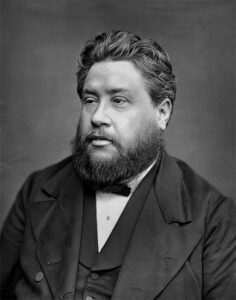
Excerpt from Spurgeon’s Sermon: Free Will—A Slave

IV. This brings us to the fourth point, THAT BY NATURE NO MAN WILL COME TO CHRIST,

It is true of all men in their natural condition that they will not come unto Christ.

The Son of God came, yet men rejected him. “Ye will not come to me that ye might have life.” It would take too much time to mention any more Scripture proofs. We will, however, refer to the great doctrine of the fall. Any one who believes that man’s will is entirely free,1Clarification – Spurgeon has earlier contrasted  “Free will” with “Free Agency”, stating, “Free agency we may believe in, but free-will is simply ridiculous. The will is well known by all to be directed by the understanding, to be moved by motives, to be guided by other parts of the soul, and to be a secondary thing. Philosophy and religion both discard at once the very thought of free-will; and I will go as far as Martin Luther, in that strong assertion of his, where he says, “If any man doth ascribe aught of salvation, even the very least, to the free-will of man [paraphrase – If anyone credits human free will with any part of their salvation, even the smallest amount], he knoweth nothing of grace, and he hath not learnt Jesus Christ aright.” and that he can be saved by it, does not believe the fall.

…Your fallen nature was put out of order; your will, amongst other things, has clean gone astray from God. But I tell you what will be the best proof of that; it is the great fact that you never did meet a Christian in your life who ever said he came to Christ without Christ coming to him. You have heard a great many Arminian sermons, I dare say; but you never heard an Arminian prayer – for the saints in prayer appear as one in word, and deed and mind. An Arminian on his knees would pray desperately like a Calvinist. He cannot pray about free-will: there is no room for it. Fancy him praying, Continue reading “The Arminian Conversion Prayer”

  • 1
    Clarification – Spurgeon has earlier contrasted  “Free will” with “Free Agency”, stating, “Free agency we may believe in, but free-will is simply ridiculous. The will is well known by all to be directed by the understanding, to be moved by motives, to be guided by other parts of the soul, and to be a secondary thing. Philosophy and religion both discard at once the very thought of free-will; and I will go as far as Martin Luther, in that strong assertion of his, where he says, “If any man doth ascribe aught of salvation, even the very least, to the free-will of man [paraphrase – If anyone credits human free will with any part of their salvation, even the smallest amount], he knoweth nothing of grace, and he hath not learnt Jesus Christ aright.”

A Calvinist Critique of Arminian Hermeneutics of Election and Salvation

Debates between Calvinism and Arminianism concerning salvation frequently center not only on doctrinal conclusions but also on differing approaches to biblical interpretation. Both traditions affirm the final authority of Scripture and seek to interpret biblical texts responsibly within their literary and theological contexts. Nevertheless, they often arrive at sharply different conclusions regarding divine election, grace, and human freedom.

This article examines several key passages commonly discussed in the debate and offers a Reformed (Calvinist) critique of Arminian hermeneutical method, particularly where Calvinist interpreters believe theological assumptions influence the reading of the text.

Definitions
Calvinist Monergism: All fallen human beings are spiritually dead due to sin. Salvation begins with God’s sovereign and effectual grace, which regenerates chosen individuals so that they are enabled to respond in faith to God’s offer of salvation. Salvation originates entirely in God’s initiative rather than in the human will. In this framework, regeneration precedes faith.
Arminian Synergism: All fallen human beings have been given God’s prevenient grace, which restores the ability to respond freely to the gospel. This grace is sufficient to enable faith but does not guarantee it. Faith is not caused irresistibly by grace but freely exercised by the individual. Salvation involves cooperation between prevenient grace and human response.

Romans 9:15–16 and the Ground of Salvation
Continue reading “A Calvinist Critique of Arminian Hermeneutics of Election and Salvation”

Will N.T. Wright Go to Heaven?

New video from N.T. Wright
What if the Reformers had Emphasized Ephesians Instead? What the Reformers Missed about Justification: –

Will NT Wright go to heaven? Given all his polemics against the idea of saved souls going to heaven, I will certainly rejoice with the angels in heaven upon hearing an affirmative answer from NTW. Furthermore, given NTW’s rejection of soul-body dualism (of which there are various forms), it would be most enlightening to know how NTW would describe the nature of his existence in heaven (however defined by NTW).

The title of the video should have been – “What NT Wright missed about justification, the soul being forgiven and received into presence of God.” Continue reading “Will N.T. Wright Go to Heaven?”

Salvation is Grounded in the Trinitarian Covenant of Redemption

Christianity teaches a unique salvation where God takes the initiative in saving humankind from the plight of sin. God “chose us in him [Christ] before the foundation of the world, that we should be holy and blameless before him. In love he predestined us for adoption to himself as sons through Jesus Christ, according to the purpose of his will…which he set forth in Christ as a plan for the fullness of time, to unite all things in Christ” (Ephesians 1: 4-5, 10). Continue reading “Salvation is Grounded in the Trinitarian Covenant of Redemption”

How Does A Triune God Have Mercy Since No One Within The Triune Godhead Needs Mercy?

I received this question in the mail last week.
QUESTION
Some Christian apologists question how Allah could be a God of love if he is absolute oneness or monadic. Who could he love before creation? In contrast, the Christian God is triune. Thus, the persons in the Trinity can love one another. This led me to reflect on another attribute of God, that is, his mercy. How does our triune God have mercy since no one within the triune Godhead needs mercy?

MY ANSWER
To your question whether the triune God had MERCY before creation – the answer is YES. God’s mercy is manifested in the Triune Covenant of Redemption.

First let me affirm your initial proposition that love is found in the triune God. Augustine, the great Christian philosopher in 5C AD shares an amazing insight which helps us grasp fully what the bible means in declaring that God is love (1 John 4:16). He  explains how love is a trinity. Continue reading “How Does A Triune God Have Mercy Since No One Within The Triune Godhead Needs Mercy?”

N.T. Wright-Scot McKnight-Matthew Bates New Perspective on Faith and Salvation

Screenshot

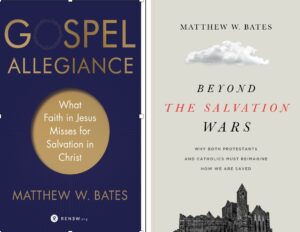
Debates about justification and New Perspective on Paul (NPP) seemed to have quietened down for a while, but recently the debates have received new impetus with the publication of three books by Matthew Bates – Salvation by Allegiance Alone, [SAA] Gospel Allegiance [GA] and Beyond the Salvation Wars [BSW]. It is undeniable that the teachings of the NPP (represented by N.T. Wright-Scot McKnight-Matthew Bates) are in conflict with the doctrine of justification and salvation taught in the historic Confessions of the Reformation. However, Bates writes, “Yet the creeds are not good stand-alone teaching tools about the gospel without an intervening reframing. The biblical and apostolic gospel relentlessly emphasizes Jesus’s messianic kingship—and this is muted in the creeds. Furthermore, creeds are doctrinal statements that invite intellectual affirmation – belief – more than allegiance.” [BSW54] Apparently, Bates seeks to intervene, reframe (and revise) the historic Reformation teaching of salvation based on his new perspective on faith and salvation, that is, salvation is by allegiance to Christ the king. Continue reading “N.T. Wright-Scot McKnight-Matthew Bates New Perspective on Faith and Salvation”

Penal-Substitution as Heart of Christ’s Atonement and its Accomplishments

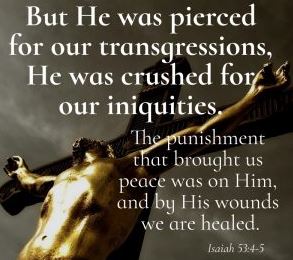
Why do Christians call the day of the crucifixion of Jesus “Good Friday”? How can an execution that results from a miscarriage of justice be good? The Christian proclamation throughout history is that it is Good Friday because on the cross of calvary, Christ took the sinner’s place (Greek: ἀντί anti, ὑπέρ huper) /1/ in bearing the guilt of man’s sin and suffering the divine punishment as our substitute in order to satisfy divine justice and bring reconciliation between God and man. “All we like sheep have gone astray; we have turned – every one – to his own way; and the Lord has laid on him the iniquity of us all…Yet it was the will of the Lord to crush him; he has put him to grief; when his soul makes an offering for guilt, he shall see his offspring; he shall prolong his days; the will of the Lord shall prosper in his hand” (Isa. 53: 6, 10). Penal-substitution is the heart of the atonement, Christ’s work of salvation.

In recent times, some theologians have highlighted alternative theories to the penal substitutionary death of Christ. I shall only focus on two of the more influential alternative theories today – the moral influence theory and the Christus Victor theory. The problem with these theories of atonement is not that they are entirely wrong. They rightly explain some aspects of Christ’s death. However, they are in reality attempts to avoid the stumbling block of penal-substitution which causes offence to modern sensibilities. These theories are deficient since they emphasize on secondary features or by-products of the atoning death of Christ in order to evade penal-substitution which is the heart of atonement. Continue reading “Penal-Substitution as Heart of Christ’s Atonement and its Accomplishments”

Series 3: The Prophecies of the Messiah and His Kingdom in the Book of Isaiah Part 4. What is Isaiah’s teaching about the New Covenant?

Question: One defining element of God’s salvation is the promise of a new covenant between God and his people which Jeremiah & Ezekiel prophesied. What is Isaiah’s teaching about the New Covenant?

Discussants: Dr. Leong Tien Fock and Dr. Ng Kam Weng.You are welcome to join the discussion at:

Part 4. What is Isaiah’s teaching about the New Covenant?

Please forward this message if you find the video discussion helpful.

Calvin on Predestination (Election and Reprobation)

Calvin’s doctrine of predestination (election and reprobation) is not a product of philosophical deduction. It is a result of Calvin’s exegesis of Scripture. Calvin gives two concise definitions of predestination:

Predestination Defined

We call predestination God’s eternal decree, by which he determined with himself what he willed to become of each man. For all are not created in equal condition; rather, eternal life is foreordained for some, eternal damnation for others. Therefore, as any man has been created to one or the other of these ends, we speak of him as predestined to life or death.” [Inst. 3.21.5]

As Scripture, then, clearly shows, we say that God once established by his eternal and unchangeable plan those whom he long before determined once for all to receive into salvation, and those whom, on the other hand, he would devote to destruction. We assert that, with respect to the elect, this plan was founded upon his freely given mercy, without regard to human worth; but by his just and irreprehensible but incomprehensible judgment he has barred the door of life to those whom he has given over to damnation. Now among the elect we regard the call as a testimony of election. Then we hold justification another sign of its manifestation, until they come into the glory in which the fulfillment of that election lies. But as the Lord seals his elect by call and justification, so, by shutting off the reprobate from knowledge of his name or from the sanctification of his Spirit, he, as it were, reveals by these marks what sort of judgment awaits them.[Inst. 3.21.7]

For Calvin, election is gratuitous, that is, it is not based on foreknowledge of merit. Continue reading “Calvin on Predestination (Election and Reprobation)”

John Calvin Against the Philosophers: Providence-Predestination vs Chance (Epicureanism) and Determinism (Stoicism)

The frequent attacks on Calvinism by non-Calvinists in the Web gives the impression that Calvinism is a pernicious Christian sect. The attacks often highlight predestination as a major problem with Calvinism. The Calvinist’s doctrine of predestination is regarded as a rigid and legalistic doctrine that violates our sense of justice. It also robs the believer of his assurance of salvation.

Critics assert that the Calvinist teaching of predestination owes more to alien philosophical arguments rather than the bible itself. This is ironic as Calvinists are often accused of relying on proof-texting and contestable exegesis when they are challenged to demonstrate the coherence of the doctrine.  The accusation that Calvinists rely more on philosophical arguments than the bible doesn’t quite match the observation that the majority of Christian philosophers are not Calvinists, but Arminians and Open Theists.

Calvinists are puzzled when critics charge them of relying more on philosophy than on biblical revelation. How can Calvinists be guilty of subordinating the bible to philosophy when they defend tenaciously two propositions which many philosophers instinctively regard as logically incompatible with one another – that God’s choice in predestination is unconditional but man is still held responsible for his decisions – because the bible says so. Obviously, Calvin’s conception of predestination is not defined within the limits of human rationality; in fact his doctrine is offensive to reason. Continue reading “John Calvin Against the Philosophers: Providence-Predestination vs Chance (Epicureanism) and Determinism (Stoicism)”