
1 John 5:1 Πᾶς ὁ πιστεύων ὅτι Ἰησοῦς ἐστιν ὁ Χριστός, ἐκ τοῦ θεοῦ γεγέννηται, καὶ πᾶς ὁ ἀγαπῶν τὸν γεννήσαντα ἀγαπᾷ [καὶ] τὸν γεγεννημένον ἐξ αὐτοῦ.
I. Does the Calvinist teaching “regeneration precedes faith” find support in Greek grammar?
Within Reformed (Calvinist) theology, it is maintained that regeneration logically precedes faith. That is, fallen human beings—being spiritually dead—are incapable of believing unless the Holy Spirit first imparts new life. This doctrine safeguards the monergistic character of salvation: it is wholly the work of God’s grace and not dependent on human initiative.
Several biblical texts are commonly cited in support of this position:
1. John 3:3–8 “Unless one is born again he cannot see the kingdom of God.” Jesus teaches that spiritual rebirth is a necessary precondition for perceiving and entering the kingdom. Faith—understood as seeing and believing—follows regeneration.
2. 1 John 5:1 “Everyone who believes [present active participle] that Jesus is the Christ has been born [perfect passive verb] of God.” The Greek construction suggests that the state of having been born of God grounds the act of believing.
3. Ephesians 2:4–5 “Even when we were dead in trespasses, [God] made us alive together with Christ.” A dead person must be made alive (regenerated) before he can exercise faith.
II. Allen’s Challenge
In his article “Does Regeneration Precede Faith?” (JBTM, 2014), David Allen challenges the Reformed interpretation of 1 John 5:1, arguing that the claim “regeneration precedes faith” cannot be proven from Greek grammar. According to Allen, “The most that can be said from the Greek present participle and perfect tense verb combination is that the actions are contemporaneous” (p. 41). He appeals to the broader context of John’s writings, noting that passages such as John 20:31 present faith as the condition for life, not its result.
Allen draws three conclusions:
1. No biblical text grammatically prescribes regeneration as preceding faith.
2. Some texts suggest faith precedes regeneration.
3. Certain passages appear to preclude regeneration preceding faith (p. 51).
III. How Greek Participles Function
To assess Allen’s claim, we must clarify how Greek participles operate.
1. Greek participles carry aspect (kind of action) rather than absolute time
Aspect refers to the quality or type of action (ongoing, completed, simple occurrence), not when it happens in time. For example:
Present participle → continuous/ongoing action (“while doing”).
Aorist participle → simple, undefined action (“having done”).
Perfect participle → completed action with ongoing results (“having already done”).
So, participles describe how an action unfolds, not when it happens.
2. Their temporal relationship to the main verb is determined by their stem
The participle’s stem (present, aorist, or perfect) signals its aspect (kind of action), which in turn indicates whether the participial action occurs before, during, or after the action of the main verb. This relationship is not governed by the tense of the main verb.
Aorist participle → usually action before the main verb.
Present participle → usually action simultaneous with the main verb.
Perfect participle → usually action completed prior, with continuing results
3. The participle’s timing is not determined by the tense of the main verb
Instead, the participle’s own aspect determines its relationship to the main verb. Consider these examples:
He will go out, having eaten → aorist participle shows prior action.
He went out, eating as he walked → present participle shows simultaneous action.
In short, Greek participles do not locate an action in absolute time. They describe the kind of action, and their timing is understood relative to the main verb on the basis of the participle’s own aspect.
[Reference: Daniel Wallace, Greek Grammar Beyond the Basics (Zondervan, 1997), pp. 614-616, 623-626].
Allen claims that “The most that can be said from the Greek present participle and perfect tense verb combination is that the actions are contemporaneous.” This is possible, but not necessary so.1Ironically, Allen exhibits the very problem that Brian Abasciano attributes to James White: a seeming unwillingness to acknowledge the plausibility of alternative readings of the text. Abasciano himself concedes that the Calvinist interpretation of 1 John 5:1 is a reasonable one, even as he advances his own Arminian reading. For further discussion, see Brian Abasciano’s article, “A Reply to James White on 1 John 5:1 and the Order of Faith and Regeneration” (available at https://evangelicalarminians.org/brian-abasciano-a-reply-to-james-white-on-1-john-51-and-the-order-of-faith-and-regeneration/). Context, discourse structure, and the semantics of the verbs involved can all affect the perceived relationship. Allen himself appeals to the context to press his case. It is possible that a present participle paired with a perfect main verb may indicate contemporaneous action. We add, however, that this is due to the present participle’s imperfective aspect, not to the perfect tense of the main verb. The main verb’s tense sets the time frame; the participle’s aspect indicates when, relative to that frame, the participial action occurs.
IV. AI Critique of Allen’s Exegesis
Allen writes,
“Many Calvinists argue that the use of “born” in the perfect tense produces a range of results expressed by present participles, and faith is one of them. However, exegesis always trumps systematic theology. Likewise, context and sentence structure trumps theology. Let’s compare John 3:18 with 1 John 5:1 to see if the use of “born” in the perfect tense produces the result of faith. Notice the order of events in John 3:18 is A then B. In 1 John 5:1 the order is B then A.
Both make use of the perfect tense. The same grammatical structure that places being born of God before faith can also be used to describe justification as occurring after faith. See Rom 5:1. The grammar of the verses does not address an ordo salutis. The use of the perfect tense in Greek provides no support for the notion of regeneration preceding faith. To suggest otherwise is to fail to distinguish between tense and aspect in Greek verbs and verbals” (p. 41).
[AI response begins] Allen makes essentially four assertions:
1. Context and sentence structure trump theology, determining sequence.
2. John 3:18 and 1 John 5:1 show reversed orders (A→B vs B→A), neutralizing any sequence argument.
3. The perfect tense alone provides no support for regeneration preceding faith.
4. Those who argue otherwise fail to distinguish tense from aspect.
V. The Irony: Allen’s Argument Refutes Itself
Here is the central irony: Allen’s fourth point is actually correct as a grammatical principle — but it destroys his own conclusion rather than supporting it.
He rightly states one must distinguish tense from aspect. But his entire comparative argument (John 3:18 vs 1 John 5:1) rests on treating the perfect tense as the key grammatical feature driving sequence — which is precisely the error of focusing on tense rather than aspect. He condemns the error in others while committing it himself.
VI. Refutation Point by Point
1. Allen correctly identifies the tool but misapplies it.
Allen insists we must distinguish tense from aspect — and he is right. But this means the argument must shift entirely to aspect, and when it does, the case for sequence in 1 John 5:1 becomes stronger, not weaker.
The sequence argument does not rest on the perfect tense of γεγέννηται alone. It rests on the interplay of aspectual signals across the whole verse:

The sequence is not read from the perfect tense alone — it emerges from the interplay of all three aspectual signals together. Allen attacks a straw man by isolating the perfect tense.
2. The John 3:18 comparison fails grammatically
Allen claims John 3:18 uses the same grammatical structure but reverses the order, therefore neutralizing the argument. Let us examine John 3:18:
ὁ πιστεύων εἰς αὐτὸν οὐ κρίνεται· ὁ δὲ μὴ πιστεύων ἤδη κέκριται, ὅτι μὴ πεπίστευκεν εἰς τὸ ὄνομα τοῦ μονογενοῦς υἱοῦ τοῦ θεοῦ.
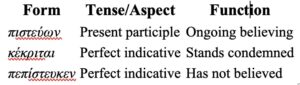
The critical difference is this: In John 3:18, πεπίστευκεν is a perfect indicative of πιστεύω itself — meaning the not-believing is presented as an already-established, settled condition that stands as the basis (ὅτι) of the condemnation. This is not structurally parallel to 1 John 5:1 at all because:
• In 1 John 5:1, believing (πιστεύων) is a present participle — aspectually imperfective and contemporaneous.
• In John 3:18, not-believing (πεπίστευκεν) is a perfect indicative — aspectually stative and already settled.
These are different grammatical constructions with different aspectual implications. Allen’s claim that they employ “the same grammatical structure” is simply incorrect. Moreover, the ὅτι clause in John 3:18 is causal: condemnation stands because the not-believing is already an established reality. If anything, this pattern actually reinforces the same logical sequence — a settled state (perfect) underlies the ongoing condition.
3. Allen Misidentifies What Carries the Sequence in 1 John 5:1
Allen writes that “the use of the perfect tense in Greek provides no support for the notion of regeneration preceding faith.” If he means the perfect tense alone settles the question, he would be formally correct — but no serious grammarian argues from the perfect alone.
The sequence argument rests on the present participle’s contemporaneity rule, a widely attested principle in Greek grammar: the present participle (πιστεύων) is contemporaneous with the standing state denoted by the perfect (γεγέννηται). The birth-state is already established when the believing comes into view. The grammar does not say that believing caused the birth — it says believing accompanies the already-present birth-state.
Allen never engages this point about the present participle. His entire argument targets the perfect tense while leaving the most important grammatical feature — the present participle’s aspect — completely unaddressed. [AI response ends]
Conclusion
Although Allen rightly emphasizes the distinction between tense and aspect, his actual analysis relies on the former in a way that undermines his argument. When 1 John 5:1 is analyzed through the lens of aspect — attending to all three verbal forms together — the grammar supports the view that regeneration precedes faith. Specifically, the participial structure presents faith as contemporaneous with an already-established state of new birth, rather than as its cause. In short, the perfect γεγέννηται expresses a completed fact with abiding consequences — the divine birth is an accomplished reality whose effects remain. The present participle πιστεύων (“believing”) used with the perfect γεγέννηται (“has been born”) indicates that believing is the continuing mark of one already born. Wallace notes that “The present was the tense of choice most likely because the NT writers by and large saw continual belief as a necessary condition of salvation.” [Greek Grammar Beyond the Basics, footnote 22 in p. 621.]
Allen cites scholars who contend that the Apostle John is not primarily concerned with establishing a cause-and-effect relationship between regeneration and faith. Rather, John presents these realities as evidence of the new birth and, consequently, of salvation. Still, it would be misleading to frame the issue as a false dichotomy between logical and temporal order. After all, causality itself presupposes both a logical and temporal relationship between cause (regeneration) and effect (faith). Although David Allen argues that 1 John emphasizes a logical rather than a temporal relationship, this distinction often proves artificial, since we generally assume that the temporal sequence of salvific events mirror their logical order. From an experiential standpoint, regeneration and faith may appear simultaneous, much like light instantly following the flip of a switch. Yet in reality, flipping the switch both logically and temporally precedes the shining of the light. In the same way, regeneration precedes faith. Colin Kruse’s description, while affirming that regeneration precedes faith, shares affinities with the illustration just mentioned, “It [born of God] is something initiated by God and effected through his Spirit, and it takes place in conjunction with faith in Christ.”2Colin Kruse, The Letters of John, Pillar NTC (Eerdmans, 2000), p. 171.
While John Stott did not engage in detailed syntactical analysis (given the limitations of the Tyndale series commentary), he nonetheless offers a more explicit and strikingly clear reading that encompasses both temporal cause-and-effect, and evidence: “The combination of present tense (ho pisteuōn, believes) and perfect is important. It shows clearly that believing is the consequence, not the cause, of the new birth. Our present, continuing activity of believing is the result, and therefore the evidence, of our past experience of new birth by which we became and remain God’s children.”3John Stott, The Letters of John (IVP, 1988), p. 172.
While our grammatical analysis of 1 John 5:1 indicates that regeneration precedes faith, this must be supported by theological exegesis. A holistic approach that considers both the immediate context of 1 John and the whole Bible is necessary to grasp the full doctrine. Comparing 1 John 5:1 with related passages that share the same Greek structure — 1 John 2:29, 3:9, 4:7, and 5:18 — reveals that John is describing the results of the new life that regeneration brings. Allen’s view that 1 John 5:1 makes faith the cause of regeneration puts the cart before the horse. In all five verses, regeneration is the source, resulting in righteousness, freedom from sin, love, or faith. Reversing this order — making faith or righteousness the cause of regeneration — does not make sense. Because divine initiative is the cause, regeneration must precede its results, including faith. This consistent pattern across 1 John (and confirmed in John 6 and Ephesians 2) resolves any ambiguity, allowing us to confidently conclude that regeneration precedes faith.
Postscript
The purpose of this article is to demonstrate how AI, when employed with caution and discernment, can serve as a valuable tool in analyzing Greek syntax. With the assistance of AI, I am able to construct a step-by-step syntactical and logical refutation of Allen’s assertion.
I am mindful that the debate over whether regeneration precedes faith remains contentious. While I possess a working knowledge of Greek, I do not claim specialist expertise. Even so, my exegesis remains open to refinement, and further input from specialists in Greek linguistics would be most welcome.
Related posts:
The current post is actually part 5 of a series of posts beginning with
A Calvinist Critique of Arminian Hermeneutics of Election and Salvation
Definite Atonement (Part 1/3): Engaging Arminian Proof Texts for Universal Atonement