Paul’s Bi-Cultural Heritage, his Gospel Message and Christology


Paul’s Bi-Cultural Heritage, Gospel Message and
Origins of Paul’s Divine Christology OPDC Part 1/6

It has been common for critics to accuse the apostle Paul of corrupting early Christianity by blending Jesus’ original, simpler message with complex Greek philosophy.

Paul’s usage of Greek terms in his gospel was simply due to the fact that koine (common) Greek became the lingua franca of the Mediterranean Greco-Roman world. These terms allow him to communicate the gospel while redefining their meanings within the bounds of the revelation of Christ. He maintains the Jewish monotheistic covenantal framework shaped by the God of Israel, covenant, law, and promise.

Universalizing the Message: His Jewish exegesis provided authoritative scriptural grounding, and his Greek fluency made his message intelligible in Gentile contexts.

Synthesis: The Prepared Apostle
Paul’s effectiveness stemmed from this unique fusion:
* He could argue from Scripture like a rabbi to Jews and God-fearers.
* He could debate in the agora and use Greek literary forms to communicate with pagans.
* He could navigate the Roman legal system to advance his mission.
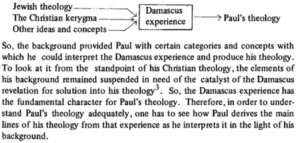
* He could theologize in a new way, using his Jewish categories (covenant, law, Messiah) to explain the universal significance of Jesus, creating a theology that transcended ethnic divisions.
 

You can watch the full video at:
Paul’s Bi-Cultural Heritage, Gospel Message and Origins of Paul’s Divine Christology OPDC Part 1/6


Related Posts:

Christological Origins of Paul’s Gospel

Historical Origin of Divine Christology Part 3 – The Origin of Paul’s Divine Christology


Secularism as Unintended Consequence of Luther’s Nominalism and Reformation (Brad Gregory)? Part 2

Secularism as Unintended Consequence of Luther’s Nominalism and Reformation (Brad Gregory)? Part 2

Were Martin Luther and the Protestant Reformation carriers of philosophical nominalism who triggered the collapse of medieval Christendom and the dawn of secular modernity? We reject this premise, demonstrating that it fails to hold up to both rigorous historical examination and orthodox theological critique.

A. Luther, Nominalism, and the Reformation
First, the historical evidence shows that while the early Luther was influenced by nominalism, the mature Luther’s theology became fundamentally Augustinian and thoroughly Christocentric in its interpretation of Scripture.

It cannot be denied that Luther began his academic career within the late medieval Ockhamist tradition. William of Ockham was one of Luther’s favored teachers in his pre-Reformation years, and Luther at times identified himself with the “terminist” or Ockhamist school. He is reported to have said, “Ockham, my master, was the greatest logician.” Yet the crucial historical question is not whether Luther was initially shaped by nominalism, but whether nominalism remained determinative for his mature theology. Continue reading “Secularism as Unintended Consequence of Luther’s Nominalism and Reformation (Brad Gregory)? Part 2”

Questions For John Calvin On God’s Providence

Several questions regarding providence are addressed in this video, including God’s justice in electing some for salvation while overlooking others, modern objections to some of God’s attributes in relation to Calvin’s discussion of God’s providence, and the relationship between God’s sovereignty and human responsibility. It ends with a summary of some practical lessons from Calvin’s treatment of God’s providence.

You may view the full video at
John Calvin on God’s Providence. Part 3/3

Next: 6-part series on “Origins of Paul’s Divine Christology” by Dr. Ng Kam Weng