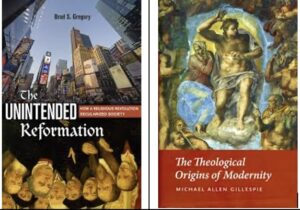
Secularism as Unintended Consequence of Luther’s Nominalism and Reformation (Brad Gregory)? Part 2
Were Martin Luther and the Protestant Reformation carriers of philosophical nominalism who triggered the collapse of medieval Christendom and the dawn of secular modernity? We reject this premise, demonstrating that it fails to hold up to both rigorous historical examination and orthodox theological critique.
A. Luther, Nominalism, and the Reformation
First, the historical evidence shows that while the early Luther was influenced by nominalism, the mature Luther’s theology became fundamentally Augustinian and thoroughly Christocentric in its interpretation of Scripture.
It cannot be denied that Luther began his academic career within the late medieval Ockhamist tradition. William of Ockham was one of Luther’s favored teachers in his pre-Reformation years, and Luther at times identified himself with the “terminist” or Ockhamist school. He is reported to have said, “Ockham, my master, was the greatest logician.” Yet the crucial historical question is not whether Luther was initially shaped by nominalism, but whether nominalism remained determinative for his mature theology.
The evidence suggests otherwise.
Luther’s Break with Nominalist Soteriology
Luther’s Disputation Against Scholastic Theology (1517) was in fact an attack on late medieval nominalist theology, especially as represented by Gabriel Biel. Biel’s theology stressed human cooperation with divine grace in the process of salvation. Although Luther continued to employ certain scholastic and nominalist forms of argumentation, he increasingly rejected the theological substance of nominalism.
Admittedly, there remained certain similarities between Luther and nominalist epistemology. Luther sharply distinguished between the Deus absconditus (the hidden God) and the Deus revelatus (the revealed God), and he displayed deep skepticism regarding the capacity of unaided human reason to attain saving knowledge of God. Yet Luther’s critique of reason was grounded not in nominalist logic, but in his biblical doctrine of sin and fallen human nature.
Luther specifically rejected Biel’s teaching that fallen human beings retain the natural ability to “do what is in them” (facere quod in se est), a core principle of late medieval nominalist soteriology. Biel argued that sinners could, by their natural powers, begin to love God and thereby dispose themselves for grace. Following Augustine of Hippo, Luther rejected this anthropology as fundamentally Pelagian. For Luther, the fallen will is not morally neutral but enslaved to sin. Human beings cannot love God above all things apart from regenerating grace. Salvation must therefore be grounded entirely in divine initiative rather than human cooperation.
Some historians argue that Martin Luther was a nominalist because his doctrine of justification by faith seemingly leaves no place for the Law. However, a closer look at his theology suggests otherwise. Nominalism (the via moderna) maintained that there are no universal moral laws and that the Law simply reflects what God arbitrarily decides. In contrast, Luther taught that the Law is not an arbitrary command, but rather reveals God’s real standard of righteousness and exposes objective sin in humanity.
Luther’s famous doctrine of justification by faith alone emerged precisely from his rejection of nominalist synergism. Nominalist theology tended toward a contractual understanding of salvation: if the sinner did his best, God might graciously reward the effort with saving grace. Yet because God’s will remained radically free, no assurance could ever exist that one had done enough or that God would in fact bestow grace.
This system plunged Luther into profound spiritual anxiety. As Gerald Bray explains:
The result of Biel’s doctrine was that the sinner was unwittingly placed under an extraordinary burden to produce good works deserving of grace… ‘Man does not know whether he is worthy of [God’s] hatred or love.’ Without that assurance, the sinner could face the prospect of hearing about God’s covenant and the justification it promised only with fear and trepidation.1Matthew Barrett, Reformation Theology (Crossway, 2017), pp, 92-93.
It took a prolonged experience of spiritual crisis — Anfechtung, the feeling of terror before an incomprehensible and terrifying God, accompanied by intense despair of conscience and doubt regarding his salvation — to shake Luther out of the nominalist soteriology that was predominant in his time. Luther insisted that while the righteous shall live by faith, assurance of salvation is possible only if justification is forensic and unconditional, grounded in Christ alone. There is no middle ground between Luther’s position and that of the nominalists
The Tower Experience and Forensic Justification
Luther’s theological breakthrough, often associated with the “Tower Experience” (c. 1515–1519), occurred when he came to understand “the righteousness of God” in Epistle to the Romans not as the divine standard by which sinners are condemned, but as the gift of righteousness granted freely to sinners through faith in Christ.
This insight decisively separated Luther from nominalist soteriology. Against the medieval view that righteousness is gradually infused into the soul, Luther argued in the Heidelberg Disputation that believers are justified by an “alien righteousness” (iustitia aliena)—the righteousness of Christ imputed to them by faith. Sanctification follows justification, but it must never be confused with the basis of acceptance before God.
While some critics worried that the notion of Christ’s alien righteousness imputed to the sinner might seem impersonal or merely transactional, Luther insisted that faith in Christ constitutes a genuine personal relationship. In writings such as The Freedom of a Christian (1520), Luther explicitly taught that faith alone unites the soul with Christ as a bride is united with her bridegroom, securing a living, personal union with Christ. The contrast with nominalism is thus clear: nominalism is premised on human merit, with grace infused through a sacramental system, while Luther’s soteriology is at its core Christological and relational.
Luther’s breakthrough theological insight was decisively out of alignment with nominalism.
Luther and Augustine
Luther’s mature theology was deeply indebted to Augustine’s doctrines of grace, predestination, original sin, and the bondage of the will. Admittedly, the early Luther initially retained aspects of the Augustinian view of justification as transformative renewal. Yet over time Luther moved beyond Augustine by articulating justification as a strictly forensic declaration grounded in Christ’s imputed righteousness.
As Michael Horton observes,
…certainly by 1535 (Commentary on Galatians), Luther was teaching that justification was a strictly forensic declaration, not a process, and consisted in the forgiveness of sins and the imputation of Christ’s righteousness through faith alone. Whatever elements of this doctrine we find in Augustine, and however one might argue that Luther was merely pushing Augustinianism to its logical conclusion, the fact remains that the two positions diverge on these points — Augustine implicitly and Luther explicitly. But we can only conclude that Luther’s view was therefore a novum if we neglect such sources as John Chrysostom…One reason for Luther’s adoption of sola scriptura was that he found in Scripture, especially Paul, the most unambiguous teaching on the subject. (Michael Horton, Justification, vol. 1, p. 228)
Luther and Sacramental Realism
Luther’s doctrine of the sacraments further distanced him from nominalism. Nominalism’s suspicion of universals weakened confidence in any metaphysical realism underlying sacramental theology. By contrast, Luther retained a robust sacramental realism. In the Eucharist, Christ is truly present “in, with, and under” the bread and wine. Luther’s theology thus preserved a strong conviction that God genuinely communicates himself through material means.
In this respect, Luther moved closer to biblical and patristic realism than to nominalist reductionism. It is therefore historically misleading to portray Luther simply as a lifelong nominalist. While nominalist categories shaped aspects of his intellectual formation, Luther ultimately transformed and transcended them within a theological framework grounded in Scripture, Christology, and Augustinian anthropology.
Indeed, the Reformers generally affirmed that creation reflects the rationality and faithfulness of God. Against radical voluntarism, they maintained that God acts consistently with his holy and rational character. The created order is intelligible because it is grounded in divine wisdom rather than arbitrary will.
Conclusion on Luther and Nominalism
The cumulative theological evidence suggests that Luther’s personal struggle with salvation, his deeper study of Scripture, and his rediscovery of justification by faith alone led him decisively away from the dominant nominalist soteriology of his age. If anything, Luther rejected nominalism because it was not sufficiently Christocentric. Its emphasis on human cooperation and uncertainty could not provide assurance of salvation or a secure knowledge of God’s grace in Christ.
Hans Boersma in his work, Heavenly Participation recognizes that the Reformers initiated a break from late medieval nominalism. He argues, however, their primary focus on doctrinal issues missed the root problem of the nominalist abandonment of a sacral world of realism which resulted in the rupture between nature and grace, ultimately leading to secularism.
Boersma’s critique fails to recognize how the Reformers resolved the nature-grace separation not through Platonic-sacramental participation but through Christology and Covenant, and union with Christ. As Boersma concedes albeit with reservation, “Certainly, Calvin not only knew of imputation but also of impartation of righteousness…While he did hold to salvation by faith alone (sola fide), he simultaneously emphasized strongly that justification (the nominal element) and sanctification (the real element) were inseparable: it was impossible to have the former without the latter…I do agree that Calvin’s participatory language did a great deal to blunt the Catholic criticism that Calvin’s forensic justification undermined a participatory ontology as well as the urgency of good works.”2Hans Boersma, Heavenly Participation (Eerdsman, 2011), pp. 93-94.
We conclude therefore that the claim that Luther and the Reformation served as the principal carriers of nominalism into secular modernity lacks adequate historical and theological foundation.
B. Toward a More Robust Historiography of Modernity
Second, the social and intellectual transformations associated with modernity were already well underway before Luther appeared on the historical stage. The late medieval world was undergoing enormous economic, political, technological, and cultural upheaval. The rise of commercial capitalism, the emergence of sovereign territorial states, the voyages of discovery, urbanization, Renaissance humanism, and the invention of the printing press were already reshaping European society. The medieval papacy itself was struggling with institutional crisis long before the Reformation. Regardless of Luther, the medieval papacy couldn’t continue as it had. Change — traumatic change — of some kind was inevitable.”
The weakness of Brad Gregory’s provocative book title is its tendency to elevate the Reformation into the major causal factor behind secular modernity rather than situating it within a far more complex matrix of historical developments. As Michael Allen Gillespie has argued, late medieval nominalism itself — antedating the Reformation — was a crucial root of the theological and metaphysical disruptions that would eventually generate secular modernity, alongside such factors as the Renaissance revaluation of the individual, the consolidation of sovereign territorial states, and the emergence of early Enlightenment philosophy in Descartes, Hobbes, and Kant. Other historians have similarly noted that the contradictions and conflicts of early modernity — the crisis of ecclesiastical and intellectual authority, the rise of independent commercial cities, and the formation of independent sovereign states — all laid the intellectual foundations of secular modernity before the Reformation can plausibly be credited with causing them.
From a Protestant perspective, Gregory’s thesis also risks reducing the Reformation to its alleged sociological consequences while neglecting its central theological claims. The Reformers were not attempting to create modern pluralism or secular individualism. They were contending for what they believed to be biblical truth: justification by faith alone, salvation by grace alone, and the supreme authority of Scripture. To judge the legitimacy of the Reformation primarily by later social fragmentation is methodologically problematic. Doctrinal truth claims cannot be evaluated solely on the basis of alleged historical consequences, especially when those consequences emerge through long and highly mediated historical processes.
A more balanced historiography would therefore situate the Reformation within a broader convergence of intellectual, political, technological, and economic forces. The Reformation was undoubtedly one important factor in the emergence of modernity, but it was not its sole or even primary origin. More importantly, contemporary historians should perhaps focus less on assigning blame for secular modernity and more on examining how modern social conditions—technological transformation, economic dislocation, moral relativism, and the erosion of traditional institutions—challenge the plausibility structures of religious belief itself.
In this respect, the secularization of Western Christianity offers important lessons not only for Christians, but also for other world religions increasingly confronted by the same historical pressures. Yet it would be premature to claim that secularization has triumphed over Christianity. Christianity has not been vanquished by secular modernity. While institutional decline has occurred in large parts of the West, there are genuine signs of renewal within the West. Furthermore, Christian faith displays remarkable vitality and explosive growth across the wider global church. Consequently, sweeping narrative of linear secularization should be regarded as overly simplistic, if not fundamentally contestable.
References
Michael Allen Gillespie, The Theological Origins of Modernity (Uni. Chicago Press, 2008).
Hans Boersma, Heavenly Participation (Eerdsman, 2011).
Michael Horton, Justification 2 vols. (Zondervan, 2018).
Related Posts
Secularism as Unintended Consequence of Luther’s Nominalism and Reformation (Brad Gregory)? Part 1
Nominalism, Humanism, and the Rise of Secularism: A Corrective to Syed Muhammad Naquib al-Attas